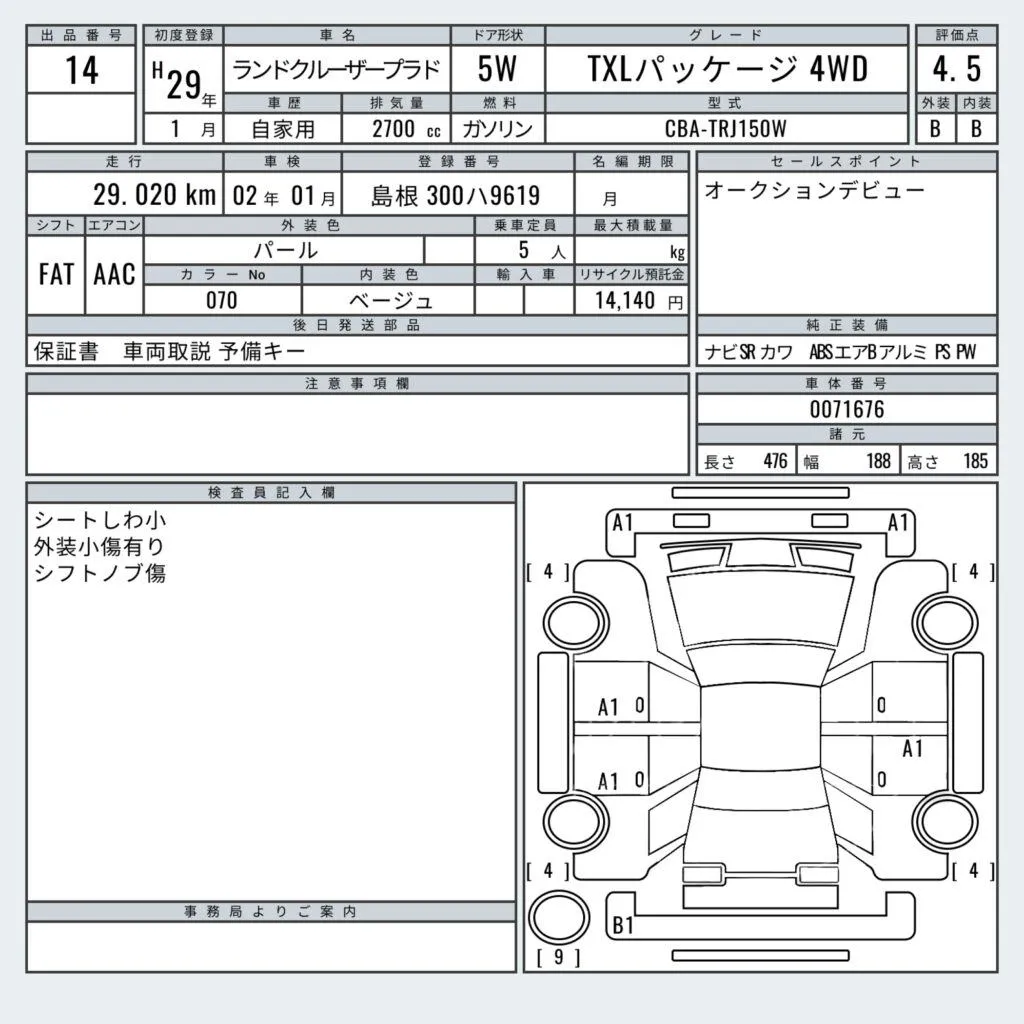
An auction sheet is the inspection record of one particular car at the auction house: the lot details, mileage, equipment, the inspector's notes and a body diagram with marks on it. An overall grade such as 4.5 is the inspector's short conclusion, not a description of the whole car, so it is read together with the diagram, the notes and the photographs of the lot.
Our teaching example — lot 14, a Toyota Land Cruiser Prado TX L Package 4WD, grade 4.5, mileage 29,020 km. Pick a field or a mark on the sheet to see its translation and an explanation; the original opens at a larger size from the link in the walkthrough. Auction houses use different forms: the layout of the fields, the set of abbreviations and the diagram legend may all differ, so this translation applies to this sheet and not to every sheet.
Hover over or select a highlighted field to see its explanation.
All explanations in text
- Lot and first registration
- Lot 14. First registration: January 2017 (Heisei 29). This is the registration date and may differ from the production date.
- Model and trim
- Toyota Land Cruiser Prado, TX L Package, four-wheel drive. 5W indicates a five-door body.
- Engine and body type
- Petrol engine, 2,700 cm³. Chassis model designation: CBA-TRJ150W.
- Overall grade 4.5
- The overall auction grade is 4.5. It describes the general condition under that auction’s rules and must be read together with the comments and diagram.
- Exterior B / interior B
- 外装 means exterior condition and 内装 means interior. Both are graded B on this sheet. Check the auction’s own criteria for letter grades.
- Mileage: 29,020 km
- The sheet states 29,020 km. The figure alone does not replace checking the documents and any additional mileage annotations.
- Transmission and climate control
- FAT means an automatic transmission with a floor selector. AAC means automatic air conditioning (climate control).
- Colour and interior
- Body colour: pearl, code 070. Interior: beige. Five seats are listed.
- First auction appearance
- オークションデビュー means the vehicle’s first auction appearance. It is a seller-field note and does not mean the vehicle is new or has never been repaired.
- Documents and spare key
- 保証書 means warranty booklet; 車両取説 means owner’s manual; 予備キー means spare key. The field refers to items sent later.
- Equipment
- ナビ means navigation; SR means sunroof; カワ means leather upholstery; ABS means anti-lock brakes; エアB means airbags; アルミ means alloy wheels; PS means power steering; PW means power windows.
- Chassis number and dimensions
- The chassis-number field shows 0071676. Length: 476 cm; width: 188 cm; height: 185 cm. Verify the identifier against the lot documents.
- Inspector comments
- シートしわ小 means minor seat creasing; 外装小傷有り means small scratches on the exterior; シフトノブ傷 means scratches on the gear-selector knob.
- A1 — front bumper
- A means a scratch. The number 1 gives its severity on the auction’s scale. Here, A1 marks appear on both sides of the front bumper.
- A1 — side panels
- The A1 marks on the side panels indicate small scratches under this sheet’s scale. Check the photos and inspection to confirm their exact locations and severity.
- A1 — right-side panel
- The right side of the diagram also has an A1 scratch mark. Match the side and panel against the diagram and vehicle photos.
- B1 — rear bumper
- B usually indicates a scratch with a dent; 1 is the severity on the auction’s scale. Here the mark is on the rear bumper. Always confirm the meaning against the auction legend.
How the sheet is laid out
The sheet fits on a single page and is divided into zones: the lot's vehicle details, technical fields, in-service data, the seller's fields, the inspector's free-form notes and the body diagram. Different people fill in these zones at different times, so they deserve different levels of trust: the identity fields are taken from the car's documents, the grade and the diagram are set by the auction house inspector or by an outside inspection company, and the seller's section reflects what the owner stated.
Vehicle details
Lot number, date of first registration, model, number of doors, trim and body variant. These fields are checked against the car's documents: a mismatch in the body number or the year is a reason to stop.
Technical fields
Engine displacement and type, transmission, air conditioning, colour and colour code, number of seats, dimensions. The trim codes sit here too: the same abbreviation can mean different things depending on the model and the year.
Mileage and roadworthiness test
The mileage at the time of inspection and the remaining validity of the Japanese roadworthiness test. Mileage is an odometer reading, not a verified history; the roadworthiness test affects costs in Japan, not the condition of the car.
The seller's fields
Marks such as "first time at auction", a list of items that will be sent later (service booklet, owner's manual, spare key) and a list of the factory equipment.
The inspector's notes
Free-form text about what the inspector saw: creases in the seats, small scratches, marks on interior trim. This is the most useful part of the sheet — the small things that never reach the overall grade appear here.
The body diagram
An outline of the car with letter-and-digit marks tied to individual panels. It shows where a defect is, not how serious it is: how pronounced it is has to be checked against the photographs and the auction house's own legend.
Grades: 4.5, interior letters, R and RA
Three different grades live on the sheet at the same time, and they should not be confused.
The overall grade is the inspector's overall conclusion. In the published USS inspection rules (the 1 October 2012 edition) and in the inspection regulations of the JU network (in force from 1 April 2013) the scale carries the same values: S, 6, 5, 4.5, 4, 3.5, 3, 2, 1 and R, plus a separate mark for cars the auction house will not grade. The values match, the criteria do not: USS gives its top S to a car with under 10,000 km and less than a year since first registration, with practically no damage or repairs, while another auction house describes the same letter in its own words. Our example carries 4.5.
Letter grades for the body and the interior are on a separate line: in our example both are B. The JU network publishes an A–E scale for the body and for the interior; the 2012 edition of the USS inspection rules gives such a table for the interior. And on the reference page of one Aucnet shop the same condition is shown with stars — that is the AIS sheet of that particular shop, not the common form of the whole auction house. So a "B" from one sheet and a "B" from another are not compared directly.
R is a mark about repair history: damage to, replacement of or straightening of structural members — the frame rails, crossmembers, inner panels, pillars, roof and floor panels. An important detail from the JU regulations: only welded joints count as the structure, bolted parts are outside the definition, so a replaced bolt-on wing on its own does not earn an R. The same document has a further mark, R1 — a car with repair history that also shows signs of flooding or of a discharged fire extinguisher.
RA is a mark that is often retold as "minor repair". It is not in the documents we checked — the 2012 USS inspection rules, the 2013 JU network regulations and the reference page of an Aucnet shop. If your sheet carries such a mark, its meaning has to be checked against that auction house's legend, not against somebody else's article. JU network inspection regulations, 2013 edition (PDF) ↗ · USS inspection process ↗
What the grade does not do: it does not confirm the mileage, it does not replace an inspection and it gives no guarantees for the future. An inspection records the condition on the day of the sale — a single figure cannot promise that the car will need nothing spent on it.
Codes on the diagram: A1, U1, W2 and their neighbours
A mark on the diagram is a letter and a digit: the letter is the type of defect, the digit is how pronounced it is. The values below follow two published JU network documents: the general 2013 inspection regulations and appendix IX of the JU Aichi association, where the rows are set out in more detail. The 2012 edition of the USS inspection rules has no such table of point codes: there the condition of the panels is described in words. A published regulation shows how the marks are built, but it does not replace the auction house's legend — for a specific lot that legend is what you read. In our example the front bumper carries A1 on both sides, the same marks appear on side panels, and the rear bumper carries B1.
| Mark | What it means | What to look at next |
|---|---|---|
| A1 – A4 | A scratch. The steps are tied to reference sizes: from "the size of a bank card" to "more than thirty centimetres". | The panel and the position: A1 on a bumper and A1 on a wing are noticed differently. |
| E | A small dent the size of a coin, with the paint intact. | How many such marks there are and which panels carry them. |
| U1 – U4 | A dent; here too the steps are set by reference sizes. | The depth, and whether a stiffening rib is affected — from the photographs. |
| UA1 – UA4 | A dent with a scratch. | This combination more often calls for repainting than for polishing. |
| W1 – W3 | Signs of repair or repainting: W1 — neatly done, W2 — the transition is visible, W3 — needs redoing. | The inspector's notes and the neighbouring marks: a W next to an R is already a conversation about the nature of the repair. |
| S1 – S3 | Rust on an outer panel. | The position: a bloom on an edge and a patch next to a structural member are different stories. |
| C1 – C3 | Corrosion, up to and including holes — the regulations have a separate mark for that. | Which panel is affected and what the inspector wrote. |
| P | A mark relating to the paintwork of a panel. | Whether it lines up with the W marks and with the repair history. |
| × / ×× | The panel needs replacing / the panel has already been replaced. | What exactly was replaced and how that relates to the R mark. |
A note on B: our example carries B1 on the rear bumper, and the JU tables we checked have no such letter. What it means on that particular form has to be reconstructed from the auction house's legend — the published regulations do not explain that mark.
The digit should not be converted into centimetres from memory. The reference sizes differ not only between auction houses: even within the JU network, two of its own documents describe the same codes once as the size of a card and once in centimetres. And the same letter outside the diagram — in the equipment field, for instance — means something entirely different.
A short crib sheet: what not to confuse
- The grade and the letter grade
- 4.5 is the verdict on the car, B is the body or the interior. These are different scales: a high grade does not cancel out remarks about the interior.
- A mark on the diagram and what it costs
- A1 says that a scratch exists and where it is. What putting it right will cost is not on the sheet.
- R and ××
- R is repair history on structural members, ×× is a mark about the replacement of a particular panel on the diagram.
- Mileage and verified mileage
- The figure on the sheet is the odometer reading on the day of inspection; marks about its reliability are read together with the documents.
- The inspector's notes and the seller's description
- The inspector writes about what they saw themselves; the seller's fields reflect what the owner stated.
Trim abbreviations
The right-hand part of the sheet is a list of the factory equipment, and it too is read against the model and the year. In our example that is navigation, a sunroof, leather trim, ABS, airbags, alloy wheels, power steering and electric windows, and in the neighbouring fields FAT (automatic transmission with a floor selector) and AAC (automatic air conditioning). The abbreviations are deceptive: AFS stands for an adaptive lighting system, not an air cleaner. Equipment is confirmed against the model catalogue and the photographs of the lot, not against three letters on a form. Toyota's AFS explanation ↗
Mileage, the roadworthiness test and the inspector's notes
The mileage on the sheet is the odometer reading on the day of inspection. It does not confirm the service history: that is checked against the service booklet, the roadworthiness test records and the lot's documents. If there is a mark about unreliable mileage next to the figure, it matters more than the figure itself.
The remaining validity of the Japanese roadworthiness test is in-service information: it speaks about costs and timing in Japan, not about the condition of the body. It affects the purchase price, not the judgement about the quality of the car.
The inspector's notes are most often what settles the matter. In our example the grade 4.5 sits next to three lines: slight creases in the seats, small scratches on the body, scratches on the selector handle. None of them spoils the grade, but these are exactly the small things the owner later sees. That is why the sheet is sent in full: a cropped fragment with the diagram contains neither the notes nor the legend.
The same happened in one of our orders: the sheet for a Honda Stepwgn Spada showed grade 4 and interior B, while the inspector's comments listed a worn steering wheel, damaged seat upholstery, minor dirt and scratches in the interior. Next to the right-hand sill the inspector also left a handwritten note that even our staff Japanese specialist could not make out. Such a line is not translated by guesswork: it is checked with the auction house or during an inspection. In this order the meaning of the note remained unknown, but on the car itself that spot turned out to be intact and tidy. The original sheet and its translation can be seen in the Honda Stepwgn Spada order story.
The reading order: six steps
- Check the vehicle identification against the lot. The model, the year of first registration, the body variant and the number have to match the documents and the description.
- Look at the overall grade and the letter grades together. The grade is the overall verdict, the letters are the body and the interior; a gap between them is already a question for the photographs.
- Check whether there is an R or an RA mark. If there is, you go on to read the diagram and the notes: what was repaired and how visible it is.
- Work through the diagram panel by panel. Write the marks out with their positions: two A1 on a bumper and a W2 on a door are not the same thing at all.
- Read the inspector's notes in full. This is usually everything that did not make it into the grades; the seller's fields are written in words too, but they reflect the owner's statements rather than an inspection.
- Compare against the photographs of the lot. If there are not enough photographs, or a mark is unclear, it is checked with the auction house before bidding.
What we do before bidding
We read the sheet in full and work through it together with the photographs: we check the identity fields, look at the marks about repairs and mileage, translate the inspector's notes and explain which defects will have to be put right after delivery. Anything disputable we check with the auction house before the sale. The procedure is set out in detail in a separate article: what we check on a car before bidding.
In our case studies you can see how this looks on actual orders: a 2014 Toyota Premio with 7,000 km and grade 4.5, a 2025 Honda WR-V with 2,827 km and grade 5 — inspected at the yard in Japan and photographed before shipping. The ordering procedure as a whole is on the page how a purchase works, and you can pick a model in the catalogue of cars from Japan.
Send us the whole sheet — we will work through the fields, the marks and the notes on your lot and tell you what is worth checking before you bid.
How the purchase works →