
Service and wheels
How to check Japanese wheel specifications before ordering
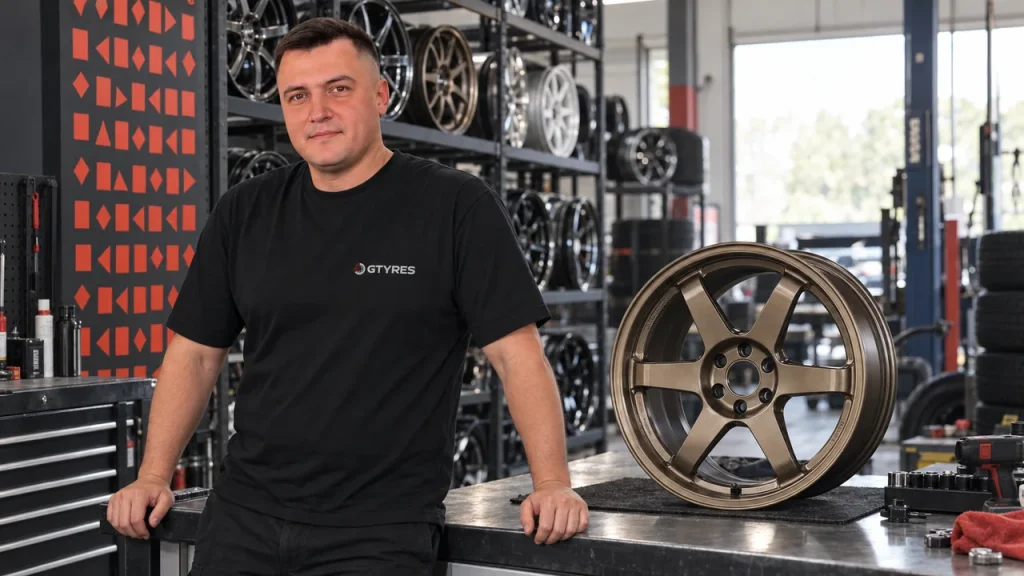
A marking such as 17×7J alone is not enough to confirm wheel compatibility. Before ordering, the wheel markings must be matched to the exact vehicle model, chassis and version. Vladimir handles wheels at GTYRES: he gathers the source details and shows what is confirmed and what still requires measurement or a trial fit.
Start with the exact vehicle
We need the make, model, year, chassis code or VIN, and the factory size. Modified brakes or suspension must be stated separately. Similar specifications can differ, so details from another year or market do not replace checks for the selected vehicle.
What to read on the wheel
- Rim diameter and width. These values must match both the vehicle and tyre size. The required tyre width cannot be determined from the wheel’s appearance alone.
- Number of holes and PCD. PCD is the diameter of the circle through the mounting holes. Both the number of holes and the PCD must match the vehicle.
- Offset, or ET/inset. This is the distance between the mounting face and the rim centreline. Changing offset changes the wheel’s position relative to the body and suspension, so we do not prescribe a universal tolerance in millimetres.
- Centre bore. We match the bore diameter to the hub and confirm whether the manufacturer specifies suitable centring parts.
- Fasteners. We check the nut or bolt seat type, thread pitch and working length. Matching PCD does not make every fastener suitable.
Why brake clearance and load need separate checks
Even when the main figures match, the wheel’s inner profile may contact the caliper, balance weights, hub projections or other parts. A confirmed application for that wheel model, a manufacturer drawing or a physical check is needed. Load markings and intended use must also match the vehicle: a standards mark does not mean one wheel fits every car.
Photographs to request for a used set
Request overview photographs of every wheel, close-ups of markings, the front and inner rim surfaces, mounting holes and mounting face. Record visible cracks, deformation, repair marks and severe finish damage separately. Photographs cannot prove that no hidden defect exists; insufficient information remains a limitation before purchase.
See our wheel service on the “Tyres and wheels from Japan” page, and available items in the GTYRES Japan wholesale catalog. To check a specific set, send Vladimir the link, photographs and vehicle details via Telegram GTYRES.