Toyota Corolla Fielder: what is the difference between petrol and hybrid versions
The Corolla Fielder is a Corolla station wagon for the Japanese market, which was produced from August 2000 to the fall of 2025 (the end date is according to the catalog) and has changed three generations during this time: E120, E140 and E160. The hybrid appeared only in the third generation, on August 6, 2013, and since then the question of “petrol or hybrid” has become the main choice when choosing. The difference is not reduced to consumption: the hybrid does not have all-wheel drive, there is a nickel-metal hydride battery under the rear seat, Toyota’s power is indicated as a “system” of 73 kW (100 hp), and not as the sum of the engine and engine, and it has its own body code – NKE165G against NZE161G, NRE161G, ZRE162G and all-wheel drive NZE164G in petrol versions. Below is what exactly is different, where the numbers come from and how not to confuse the Fielder with the Corolla Touring, which has been sold in parallel since 2019.
Three generations of a single station wagon
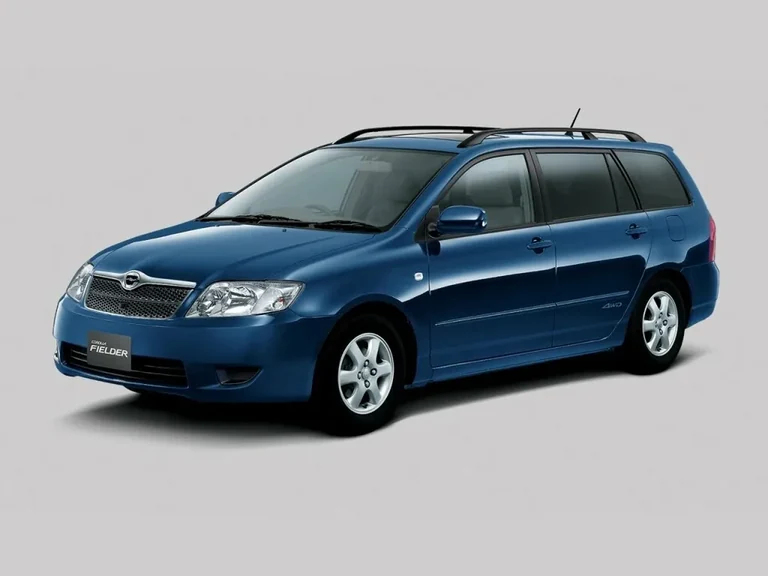
The Fielder name appeared on August 28, 2000, when Toyota updated the Corolla and renamed the Corolla Wagon. The first generation (E120) was offered with four engines: 1.5 liters 1NZ-FE – 81 kW (110 hp) on front-wheel drive and 77 kW (105 hp) on full-wheel drive, 1.8 liters 1ZZ-FE – 100 kW (136 hp) and 92 kW (125 hp) respectively, 2.2-liter 3C-E diesel – 58 kW (79 hp) and only in the station wagon – 1.8 liters 2ZZ-GE with variable valve height VVTL-i, 140 kW (190 hp) at 7,600 rpm for the Z Aero Tourer version with 6-speed manual or automatic transmission with paddle shifting. All-wheel drive is a permanent V-Flex with viscous coupling and double wishbone rear suspension. In the body code E120, all this is read directly: NZE121G – 1.5 liters, NZE124G – 1.5 liters with all-wheel drive, ZZE122G and ZZE124G – 1.8 liters, ZZE123G – 2ZZ-GE, The CE121G is a diesel; the letter G at the end distinguishes a station wagon from a sedan. Updates took place in September 2002 and April 2004, when versions with the 2ZZ-GE received a “performance dumper” between the suspension cups and a 10 mm lower suspension, and the 1NZ-FE became more fuel-efficient. Catalog entries: E120 before 2002, 2002–2004 and 2004–2006.
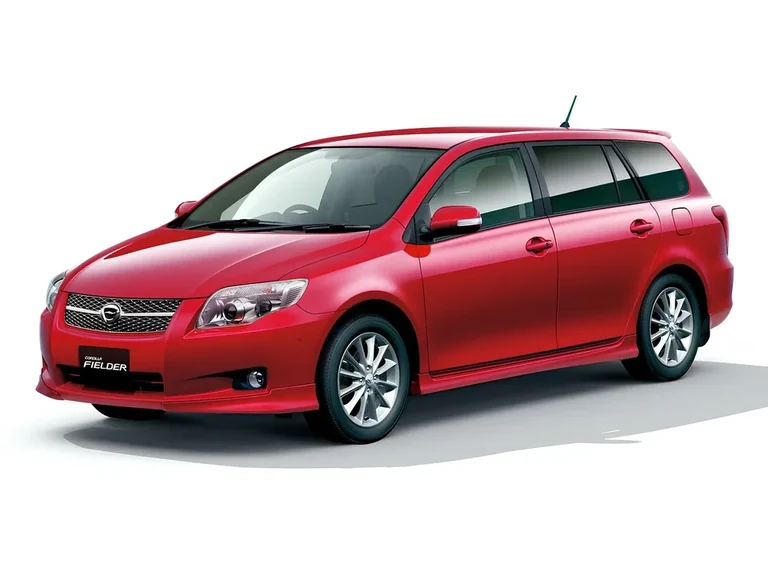
The second generation (E140) was released on October 10, 2006 along with a sedan, which became known as the Corolla Axio. The lineup was simplified to two petrol engines: 1.5 liters 1NZ-FE – 81 kW (110 hp) and 140 Nm – and the new 1.8 liters 2ZR-FE with Dual VVT-i – 100 kW (136 hp) and 175 Nm; both worked with the new Super CVT-i CVT, the 1.5 liter had a 5-speed manual on the front-wheel drive, both versions had all-wheel drive. The station wagon received a rear seat that folds down in one movement. In April 2010, all 1.8-liter versions switched to the 2ZR-FAE with a Valvematic mechanism, and the 1.5-liter with CVT on front-wheel drive reached 20.0 km/l on a 10·15 cycle. The codes are NZE141G and NZE144G for the 1.5 liters, ZRE142G and ZRE144G for the 1.8 liters, the four in third position again means 4WD. In the catalogue there are the E140 before the update and after October 2008.
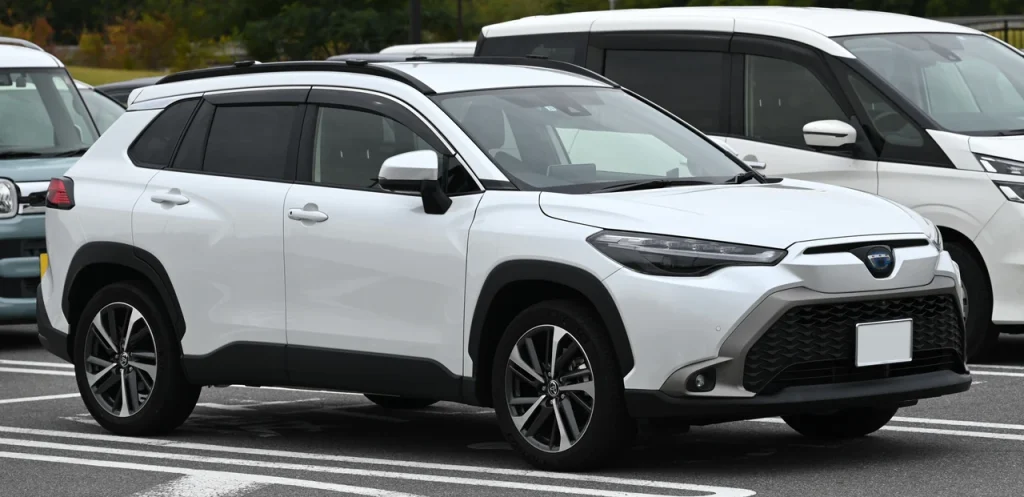
Toyota introduced the third generation (E160) on May 11, 2012 under the slogan “spacious compact”: the station wagon became shorter by 60 mm, but the trunk length increased by 90 mm, and with the seats folded down – by 410 mm. It is this generation that lasted until 2025 (according to the catalog data), and it is the one that has a hybrid. All its versions are collected in the records 2012-2015, 2015-2017 and since October 2017.
Petrol versions of the E160: three engines for 1.5 and 1.8 liters
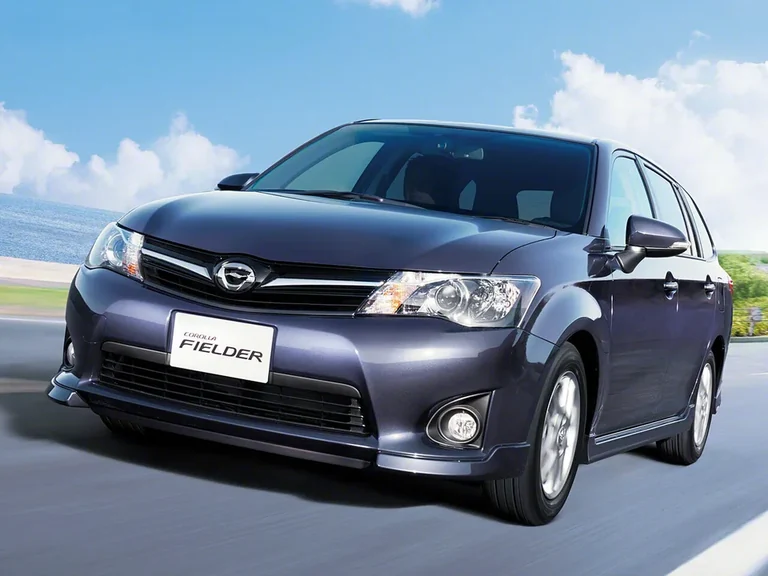
At the start in 2012, there were two petrol engines. The main one is a modified 1.5 liter 1NZ-FE with the new Super CVT-i, 19.6 km/l according to JC08 for the front-wheel drive version and 21.2 km/l with the Stop & Start system; It was also installed on all-wheel drive (only with a CVT) and on front-wheel drive versions with a 5-speed manual. The second is 1.8 liters 2ZR-FAE for version 1.8S, only front-wheel drive and only a CVT, but with a sports mode and 16.6 km / l. In March 2015, simultaneously with the first Toyota Safety Sense C package in history, a third engine appeared: a new 1.5 liter 2NR-FKE with an Atkinson cycle and an electric VVT-iE phase, 23.0 km / l according to the JC08 station wagon. It went only to front-wheel drive versions with a CVT, and the 1NZ-FE remained on mechanics and on all-wheel drive – this can be seen from the Toyota tables of 2015 and 2017, where against 4WD there is always 1NZ-FE. The power of E160 petrol engines is not given in Toyota releases; according to catalog data, 1NZ-FE gives 103-109 hp. depending on the gearbox and drive, 2NR-FKE – 109 hp, 2ZR-FAE – 140 hp.
Hence the rule for reading the code for the petrol E160: NZE161G – 1NZ-FE on front-wheel drive (manual or CVT), NZE164G – 1NZ-FE with all-wheel drive, NRE161G – 2NR-FKE (CVT, front-wheel drive, since 2015), ZRE162G – 1.8 liters 2ZR-FAE. Pages of codes in the catalog: NZE161G, NZE164G, NRE161G, ZRE162G. The update of October 2017 did not touch the engines: the Intelligent Clearance Sonar parking auto-brake and Toyota Safety Sense C were added for all versions. And in September 2019, when releasing the Corolla Touring, Toyota announced that the Axio and Fielder would remain on sale with a revised lineup – only EX and HYBRID EX; the 1.8-liter version ended there. In September 2021, the station wagon received Toyota Safety Sense with pedestrian recognition during the day, in August 2022 – LED headlights and USB Type-C, Fielder prices then ranged from 1,758,400 to 2,330,400 yen.
Hybrid: What Toyota Says and What It Means in Practice
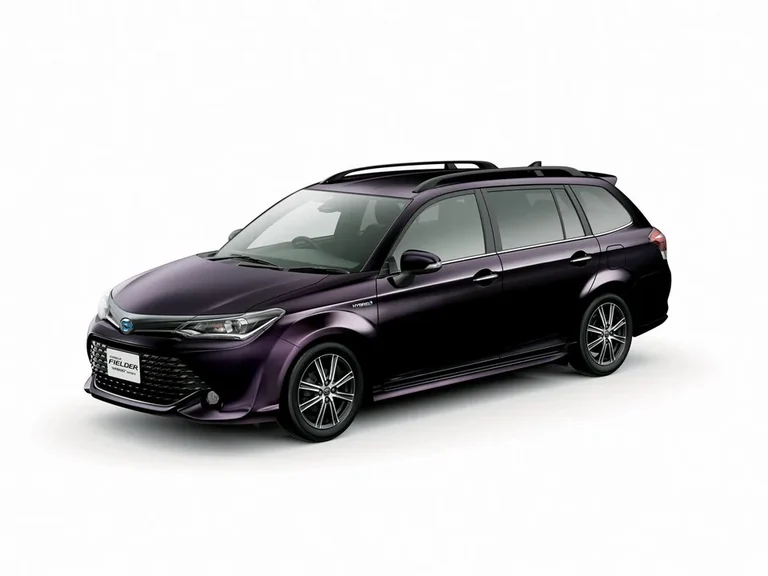
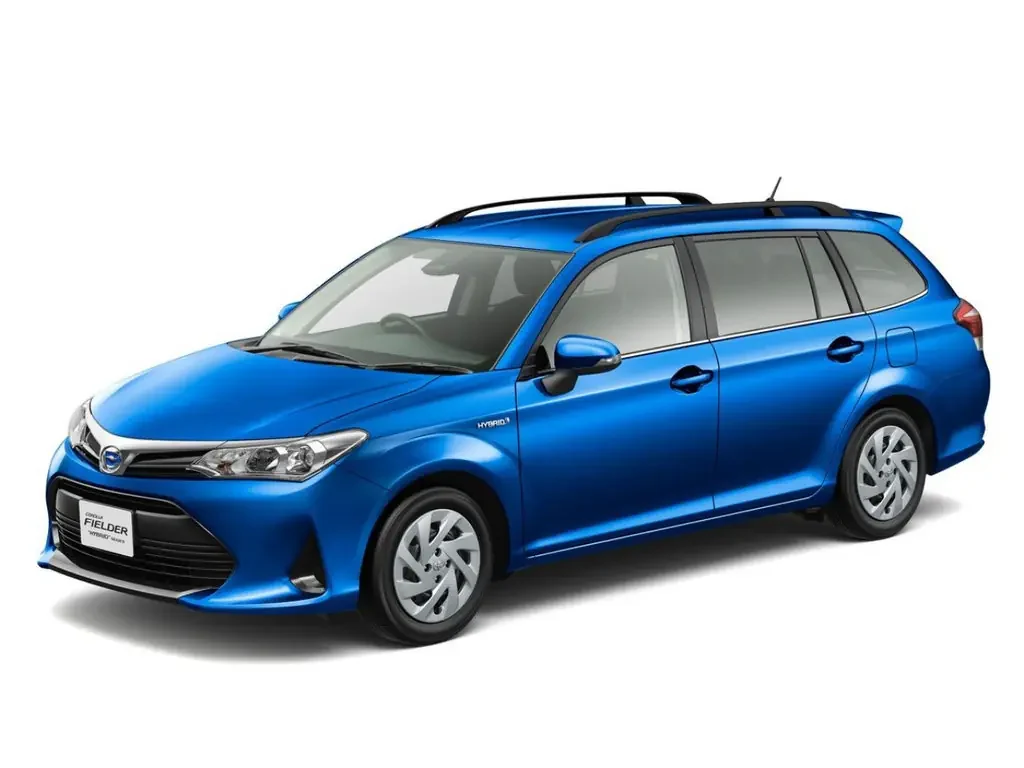
The hybrid Fielder was released on August 6, 2013 with a THS II system with a gearbox. The 1NZ-FXE engine with a volume of 1,496 cm³ produces 54 kW (74 hp) at 4,800 rpm and 111 Nm, the electric motor is 45 kW (61 hp) and 169 Nm, and the power of the Toyota system is indicated separately: 73 kW (100 hp), and this is the only number that can be written in the column “hybrid power” – you cannot add 74 and 61, why so, is analyzed in the article about the power of a hybrid from Japan. The battery is nickel-metal hydride, located under the rear seat, so the trunk of the hybrid is the same as that of the petrol versions: 407 liters with five passengers and 872 liters with the rear row folded, and the knee room in the back remained 640 mm. Consumption according to the JC08 is 33.0 km / l at the start, 33.8 km / l after the 2015 update and 34.4 km / l from October 2017, when Toyota reconfigured the control of the engine and inverter. Front-wheel drive only: Fielder does not have an all-wheel drive hybrid, and if 4WD is needed, the choice comes down to petrol NZE164G with 1NZ-FE and CVT.
The hybrid versions at the start were called HYBRID and HYBRID G, plus a special version of the HYBRID G “AEROTOURER·W×B”; from 2019 only one remained – the HYBRID EX. Unlike petrol cars, the hybrid has two modes on the buttons – Eco Drive Mode and EV Drive Mode for short driving only on electric traction, an uphill start assistant and a 4.2-inch color screen with a system indicator. The body code of the hybrid is NKE165G, catalog page: NKE165G.
How to distinguish a hybrid from petrol by code and documents
The most reliable sign is the body code in the auction sheet or in the 型式 column of the documents: NKE – hybrid, NZE, NRE and ZRE – petrol. The second feature is the name of the version: a hybrid always has the word HYBRID (HYBRID, HYBRID G, HYBRID EX) in it, petrol – 1.5X, 1.5G, 1.8S or EX. The third is drive: an all-wheel drive station wagon cannot be a hybrid, and 4WD for petrol cars is read by the four in the code (NZE164G) and by the mark in the sheet. Finally, for versions of 2015 and newer, it is worth checking the presence of Toyota Safety Sense C – on the first updated cars, the package was an option for HYBRID and 1.5X, it became standard for everyone in October 2017. How Japanese codes are read in general is explained in the article on the body code.
Fielder and Corolla Touring are different cars
On September 17, 2019, Toyota released the Corolla Touring, a new generation Corolla station wagon on the TNGA platform, with a 1.8-liter 2ZR-FXE hybrid, a 1.8-liter 2ZR-FAE petrol engine and a 1.2-liter manual turbo engine. It is noticeably larger: 4,495 mm long and 1,745 mm wide, which is 50 mm wider than the previous model, which transfers the car from the Japanese 5-number class to the 3-number. At the same time, the Fielder was not discontinued: in the same release, Toyota wrote that the former Axio and Fielder remain on sale with the EX and HYBRID EX versions, and this continued until 2025. Therefore, in the ads of 2019-2025, both station wagons are found, and they should not be confused: the Touring has a different 1.8-liter hybrid, there is a version with electric all-wheel drive E-Four, and the Fielder has a compact body with a width of 1,695 mm and a hybrid of 1.5 liters. In the catalogue they are kept separately: Corolla Fielder and the twelfth-generation Corolla station wagon, that is, the Touring.
What to check before buying
For a hybrid, the main thing is the condition of the battery and the service history: in auction sheet, the assessment of the body does not indicate the resource of the high-voltage battery, so you need mileage, a year and, if possible, diagnostics from the seller. For petrol cars, what kind of engine is hidden behind the “1.5 liters”: 1NZ-FE and 2NR-FKE do not differ from the outside, but they have different codes (NZE161G and NRE161G), different efficiency and different gearboxes – the 2NR-FKE only has CVT. All-wheel drive Fielder is always 1NZ-FE with a CVT. The 1.8S version is only found until 2019 and only with front-wheel drive. For cars after September 2021, Toyota Safety Sense with daytime pedestrian recognition became the standard, and for earlier (since March 2015) Toyota offered a software update by the dealer – you will have to check whether it is installed with the seller. What GTYRES checks for the lot before bidding, is described in a separate article, the selection conditions are on the page about cars from Japan.