Honda N-BOX: generations and versions by body code
The Honda N-BOX is a popular Japanese kei-van: according to Honda, cumulative sales of the series in Japan at the end of April 2026 exceeded 3 million cars, and according to the results of the fiscal years (April-March), the model has led sales of new cars in the country for five years in a row along with "full-size" cars and eleven years in a row among kei…
The Honda N-BOX is a popular Japanese kei-van: according to Honda, cumulative sales of the series in Japan at the end of April 2026 exceeded 3 million cars, and according to the results of the fiscal years (April-March), the model has led sales of new cars in the country for five years in a row along with “full-size” cars and eleven years in a row among kei cars. For a buyer from Russia, such a mass character turns into confusion: in fifteen years, three generations have changed, each has a Custom version, N-BOX+, N-BOX SLASH and N-BOX JOY were sold side by side, and externally they are all the same high boxes. The easiest way to figure it out is by body code: JF1 and JF2 are the first generation (2011-2017), JF3 and JF4 are the second (2017-2023), JF5 and JF6 are the third (from October 2023), and the odd number always means front-wheel drive, and the even number always means full-wheel drive. The engine of all three generations is of the same type, a 0.66-liter three-cylinder, naturally aspirated or with a turbine, and it is the supercharging, and not the generation, that determines how the car drives with four people on board. Below is what has changed in each generation according to Honda releases, how the Custom differs from the basic version, and what to check in the announcement. A comparison of the four current versions in terms of price and consumption is placed on a separate page about the third-generation versions, and all the years and codes are collected in the N-BOX catalog.
One type of engine and two digits in the body code
All N-BOXES are built around a three-cylinder engine with a volume of 0.66 liters – in the first generation it is the S07A series according to catalog data: the atmospheric version produces 43 kW (58 hp) at 7,300 rpm and 65 Nm, the turbocharged version – 47 kW (64 hp) at 6,000 rpm and 104 Nm already with 2,600 rpm. There is only one gearbox – a CVT, front-wheel drive or all-wheel drive. The difference between the atmospheric and turbo versions is not in peak power, but in the traction at low speeds: the naturally aspirated engine with almost a ton of body has to spin to high speeds, the turbo pulls calmer and quieter on the highway. The body code shows only the drive and generation: JF1, JF3 and JF5 – front-wheel drive with a semi-independent beam at the rear, JF2, JF4 and JF6 – all-wheel drive with rear suspension of the De Dion type. The dimensions of all three generations rest within the class limits in length and width – 3,395 and 1,475 mm with a wheelbase of 2,520 mm – and a height of about 1.8 m (the second generation according to catalog data is 1,790-1,815 mm, depending on the drive), so you have to distinguish the generations by body details and by the date of manufacture in the documents. How Japanese codes work in general is explained in the article on body code.
JF1 and JF2, 2011–2017: the first N-BOX, N-BOX+ and SLASH
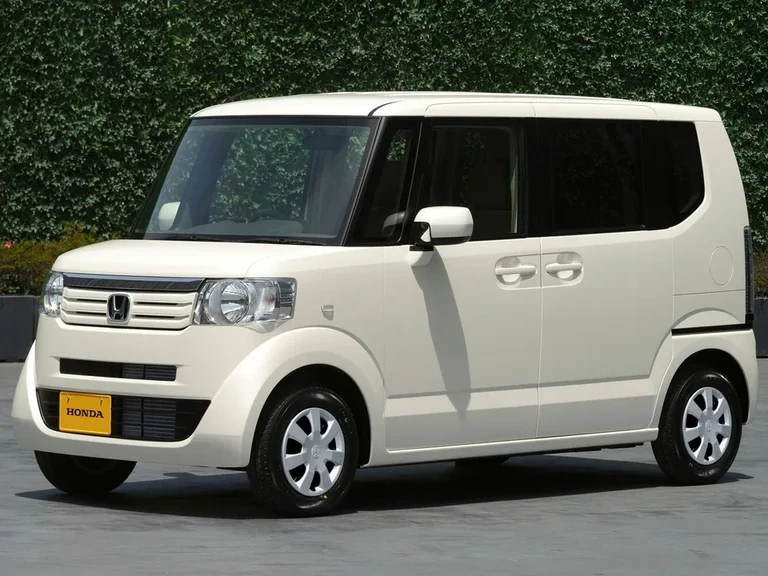
The N BOX (then still without a hyphen) was released on December 16, 2011 as the first model of the new “N” series. Honda moved its central gas tank under the front seats, familiar from the Fit, to the kei car, and received an interior that it called the maximum among kei cars: the interior length is 2,180 mm, the sliding door opening is 640 mm – wider than the Freed minivan. Honda itself described the car as a “mini-minivan”. From day one, there were two lines: the basic N BOX and the N BOX Custom with a different front end and a darker interior, and the turbine in 2011 was offered only in the Custom version in the G version Turbo Package. Consumption according to the Japanese JC08 cycle for the front-wheel drive naturally aspirated version is 22.2 km/l, prices at the start are from 1,240,000 yen for the basic version to 1,780,000 for the all-wheel drive Custom Turbo. Catalog entry – N-BOX 2011–2015, codes JF1 and JF2.
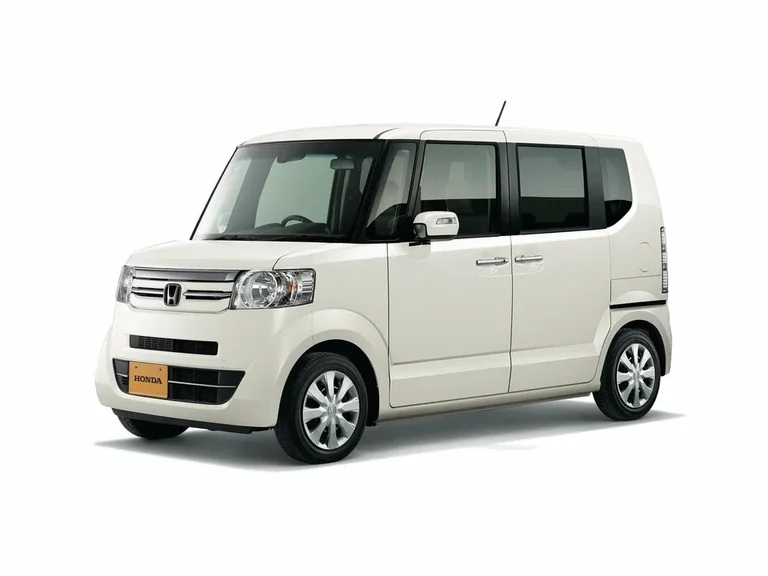
Then the series grew in breadth. On July 6, 2012, the N BOX+ appeared – the same body and JF1/JF2 codes, but with a flat “bridge” floor from the rear door to the front seats, a sloping rear roof and versions for transporting a wheelchair; its turbo engine was offered on all trim levels. On December 22, 2014, the N-BOX SLASH was released – a box with a lower roof and a “compartment” silhouette, consumption of 25.8 km/l and interior trim packages like Diner Style. Both lines were closed a long time ago: according to footnotes in Honda releases, sales of the N-BOX+ were discontinued in August 2017, SLASH in February 2020, and in ads they are found as separate models with their own names. These are also separate entries, and they are not yet in the GTYRES catalog.
On February 5, 2015, the N-BOX changed its appearance for the first time: new bumpers and grilles for the basic version and the Custom, for the turbocharged Custom – LED dimensions and fog lights as standard, all – the option of a sliding rear sofa and windows with UV and heat protection. The consumption of the naturally aspirated front-wheel drive version has grown to 25.6 km/l. It is these cars of 2015-2017 that are the youngest N-BOXES of the first generation: they have the same body code JF1/JF2, on the outside they are distinguished by bumpers and an updated grille, but it is more reliable to focus on the date of manufacture in the documents. Catalog entry – N-BOX 2015-2017.
JF3 and JF4, 2017-2023: Honda SENSING as standard and new platform
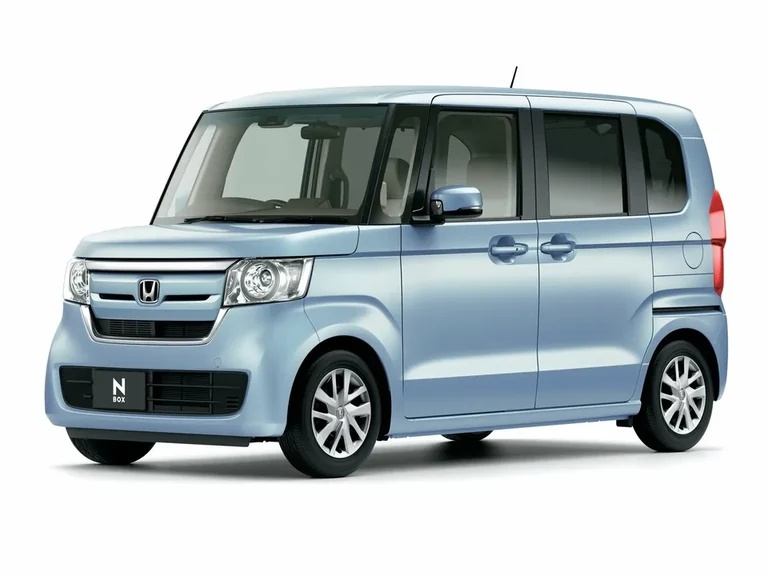
The second N-BOX went on sale on September 1, 2017 with a new platform and a new power unit: with the previous dimensions, the car became about 80 kg lighter, the naturally aspirated engine received the i-VTEC system, the turbocharged one received an electric westgate, both of which Honda called first in class. LED headlights became standard on all versions, and most importantly, the Honda SENSING complex with automatic braking, adaptive cruise control, lane keeping and sign recognition appeared on all versions; The N-BOX became Honda’s first kei car with this system. There is a caveat that is important for the buyer: in the 2017 release, Honda directly writes that on the atmospheric versions – G, G· L and G· EX in the base N-BOX and G· L, G· EX from Custom – the complex could not be ordered (turboversions came only with it), so the cars of the first years of the second generation should check the presence of Honda SENSING on the auction sheet, and not take it for granted. Of the convenient things – the front passenger seat with a longitudinal travel of 570 mm, which slides almost to the rear sofa, and the Slope version with a folding ramp for the stroller from April 20, 2018. Prices at the start are from 1,385,640 yen. Codes – JF3 and JF4, catalog entry – N-BOX 2017-2020.
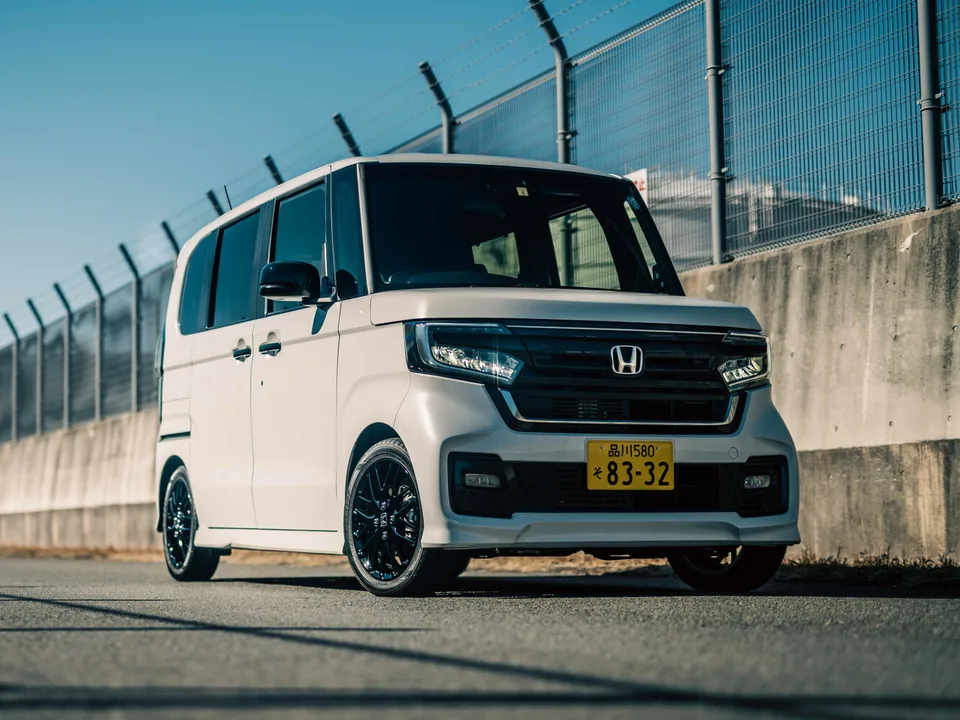
On December 25, 2020, the generation was updated: the base N-BOX received a quieter front end with a chrome bar in the lower grille and a dark brown interior, the Custom received a more massive chrome grille and a license plate moved to the center of the bumper, plus there were “coordinated styles” with their own wheels and trim and parking sensors on the four rear sonars. A year later, on December 17, 2021, by the tenth anniversary of the model, all versions received an electronic parking brake with auto-hold, and the cruise control learned to follow the flow in traffic until it came to a complete stop. This is a simple guideline when choosing within the second generation: a car with a mechanical parking brake – until the end of 2021, with an electronic button – after. Catalog entry – N-BOX 2020-2023.
JF5 and JF6, from 2023: third generation, JOY and 2026 update
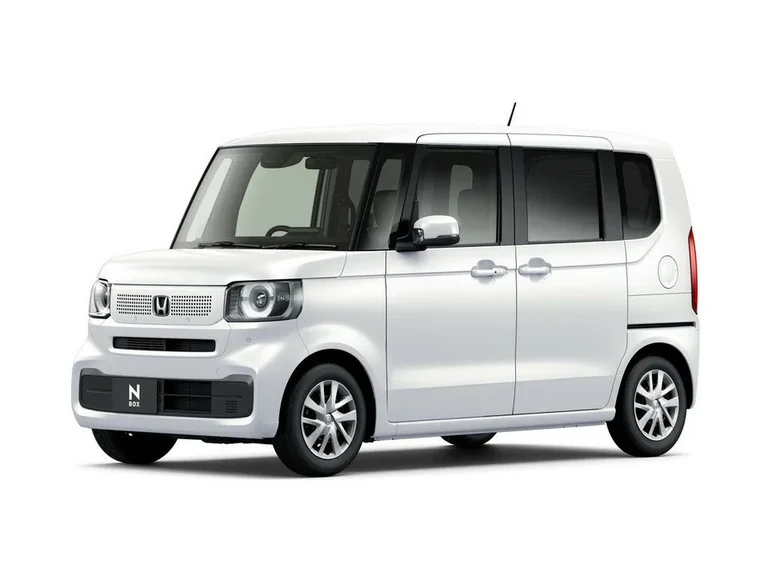
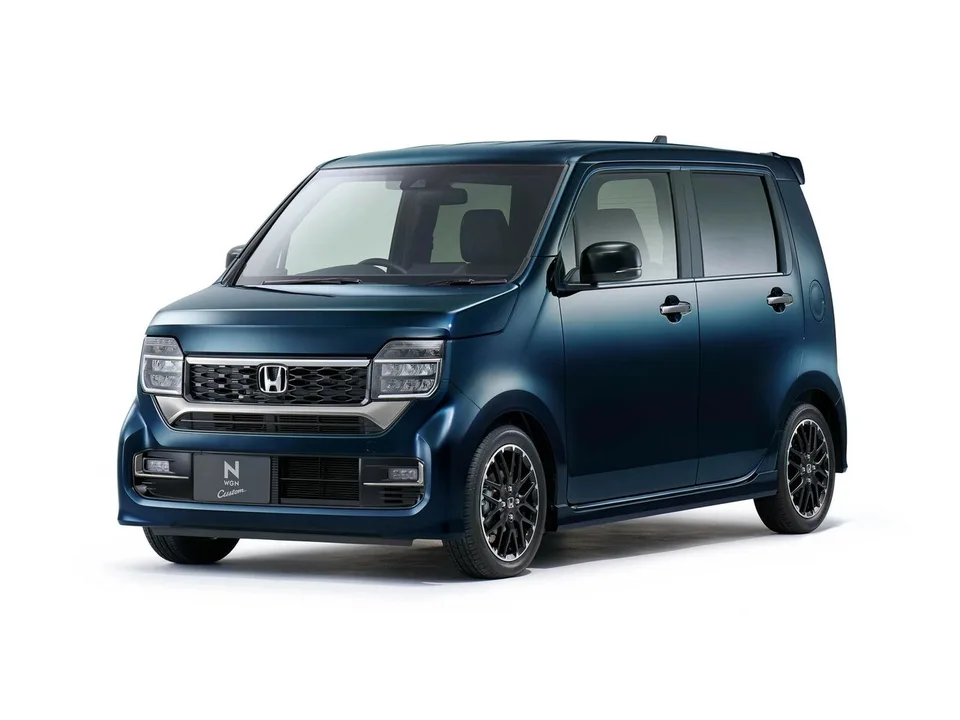
The third N-BOX has been on sale since October 6, 2023. Honda deliberately transferred the power unit from its predecessor – a naturally aspirated engine with VTEC and a turbo with electric westgate, reconfiguring the CVT – and changed what surrounds the driver: the 7-inch instrument screen is readable inside the rim of the steering wheel, the dashboard has become flat, the auxiliary mirror from the left pillar has gone into the side mirror housing, and the forward view is noticeably better. For the first time, Honda’s kei car has a Honda CONNECT telematics module, the Honda SENSING complex now works from a wide-angle camera and eight sonars and can brake at short distance and dampen accidental gas presses. In the JNCAP safety assessment for fiscal year 2023, the N-BOX received the highest five-star rating. The third-generation codes are 6BA-JF5 for front-wheel drive and 6BA-JF6 for full-wheel drive; in the catalog, these are pages JF5 and JF6 and an entry for N-BOX from 2023.
On September 27, 2024, the series received a third model, the N-BOX JOY, a “tool for active living” based on the regular N-BOX: black bumpers and trims, checkered water-repellent seats, and a trunk floor raised by 80 mm so that after folding the rear sofa, an almost flat area was obtained, which Honda called a “flat terrace”. The JOY has both an atmospheric and a turbo version. On April 18, 2025, Custom received LED fog lights on some versions, and on July 17, 2026, the entire generation was updated: the Custom has a new front end with a large chrome grille, a full-width light strip and square fog lights, the JOY has a special version of BLACK STYLE, and the “fashionable style” of the basic version has a white roof. Prices after the update range from 1,768,800 yen for the base N-BOX to 2,436,500 for the Custom Turbo and 2,598,200 for its “coordinated style”. The updated cars in the catalog are separated from the 2023-2026 edition – N-BOX from 2026.
Custom, Turbo and 4WD: how to read the version name
Custom is not the engine or equipment, but the exterior and interior: a different front end with a lot of chrome and full LED optics, a black interior instead of a light one, in the third generation – its own headlights with a directional projection and an aerodynamic body kit. The turbine is designated separately by the word Turbo in the version name: G · Turbo, L·Turbo, EX· Turbo, Custom Turbo, JOY Turbo; the Custom version without this word is atmospheric. In 2011, the turbine was only supposed to be Custom, by the 2015 update, the base N-BOX also received the G· Turbo L Package, in the second generation both lines had a turbo, and in the third it was again left to the Custom and JOY. All-wheel drive is visible by the even body code – JF2, JF4, JF6 – and is not associated with either the Custom or the turbine: there are all-wheel drive naturally aspirated base versions and front-wheel drive Custom Turbo. Further years follow: in the first generation, updated bumpers and grille mean the car after February 2015, in the second, the number relocated in the center of the Custom – after December 2020, and the electronic handbrake button – after December 2021; in the third generation, only cars after July 2026 have a new Custom grille and a white roof of the “fashionable style”. All three generations are four-seaters: there is no fifth place in the N-BOX in any version.
What to check before buying
First, the body code and the year in the auction sheet must match each other and what is visible in the photos: JF1/JF2 – until 2017, JF3/JF4 – 2017-2023, JF5/JF6 – from the fall of 2023. Then the name of the version: the words Turbo, Custom, JOY, Slope – each means a different car with the same code. In the second generation of the first years, it is worth making sure that Honda SENSING is installed, and not removed by order of the first owner; the cars will not have an electronic handbrake and a “cork” cruise until December 2021. The electric drive of the sliding doors and its presence on both sides is also a matter of version, not generation, and it is worth checking the sheet. Consumption according to the JC08 of 22-26 km/l belongs to the front-wheel drive naturally aspirated version; in all-wheel drive and turbocharged it is worse: the spread in the first generation is from 25.2 to 18.8 km/l. How to read the ratings in the list – on the page about the decoding of the auction sheet; other kei cars are collected in the catalog selection, and the cost with delivery for a 0.66-liter engine is calculated in the calculator – the engine size and date of manufacture are included in the calculation directly.