Honda N-WGN: Generations, Body Codes and Custom Differences
The Honda N-WGN is a tall kei car from the same N family as the N-BOX and N-ONE: the same platform with a gas tank under the front seats, the same 0.66-liter naturally aspirated or turbocharged three-cylinder engine, but the body is about 12 cm lower than that of the N-BOX, and without sliding doors - an ordinary five-door hatchback that is bought in Japan…
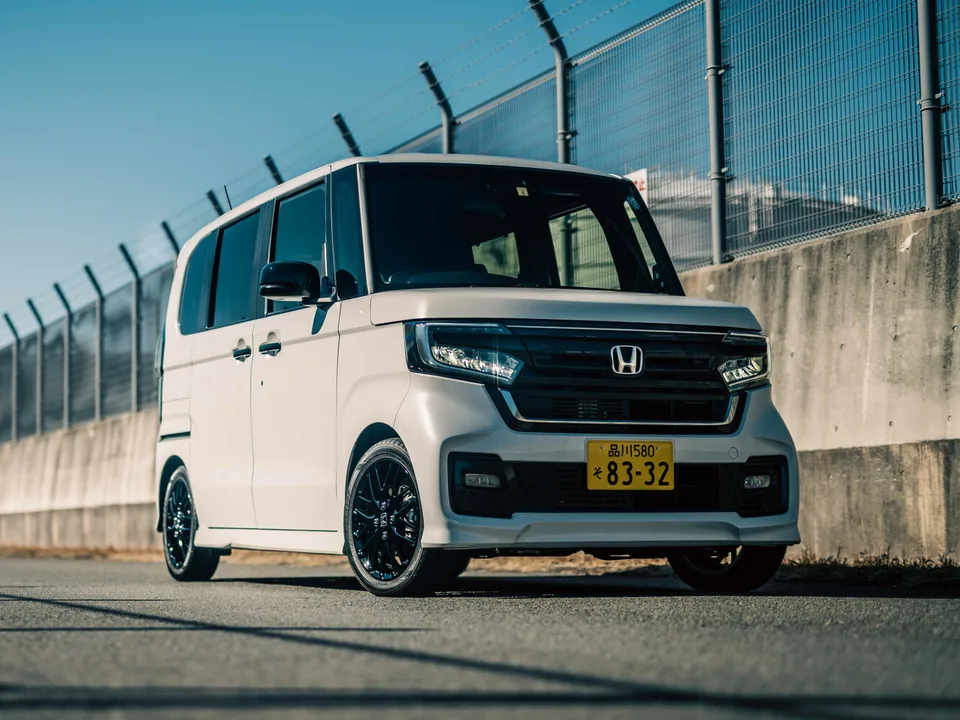
The Honda N-WGN is a tall kei car from the same N family as the N-BOX and N-ONE: the same platform with a gas tank under the front seats, the same 0.66-liter naturally aspirated or turbocharged three-cylinder engine, but the body is about 12 cm lower than that of the N-BOX, and without sliding doors – an ordinary five-door hatchback that is bought in Japan for every day. In twelve years, the model has changed only two generations, and this is what confuses the buyer: in the ads there are four different body codes, two exterior updates, a Custom version with a different face and a dozen trim level names. The easiest way to figure out is by the code in the documents: JH1 and JH2 are the first generation (November 2013 – June 2019), JH3 and JH4 are the second (from August 2019), and the odd number always means front-wheel drive, and the even number always means full-wheel drive. At the same time, Custom is not a separate generation, but a design option with its own bumpers, grille and optics, which is produced next to the base car from day one. Below is what has changed in terms of releases and the Honda archive, how Custom differs from the usual N-WGN in photos and documents, and what to look at in the auction sheet. All years, codes and versions are collected in the N-WGN catalog, and there is a separate article about the N-BOX, which has the same technology and similar code logic.
Two generations, four codes and a prefix before them
The N-WGN body code is read in the same way as for the rest of the N series cars: the letters JH are assigned to the model, the number means generation and drive. In the first generation, these are JH1 (front-wheel drive) and JH2 (full), in the second – JH3 and JH4. In the Japanese registration certificate, the code is written together with the prefix of letters and numbers: DBA-JH1, 6BA-JH3, 5BA-JH3. The prefix does not describe the car, but the environmental category for which it was certified, so it changes along with emission standards, and not with the generation: the second generation started as 6BA-JH3/JH4, and after finalization in September 2025, it is already listed in the catalog as 5BA-JH3/JH4 with the same body and engine. How the body code works in general and where to look for it in the documents is analyzed in the article about the body code of a Japanese car. The table itself is short:
| Code (in documents) | Generation and years in Japan | Engine | Drivetrain |
|---|---|---|---|
| JH1 / JH2 (DBA-JH1, DBA-JH2) | First, November 2013 – June 2019; Update in June 2016 | S07A, 0.66 l: 58 hp, turbo 64 hp; CVT | front-wheel drive / all-wheel drive |
| JH3 / JH4 (6BA-JH3, 6BA-JH4) | Second, from August 2019; update in September 2022 | S07B, 0.66 l: 58 hp, turbo 64 hp; CVT | front-wheel drive / all-wheel drive |
| JH3 / JH4 (5BA-JH3, 5BA-JH4) | Second after refinement in September 2025: Fashion Style version, Custom BLACK STYLE series | The same motors | front-wheel drive / all-wheel drive |
The power in both generations is the same – 58 hp naturally aspirated and 64 hp with a turbine, this is the ceiling set for the kei class – but the engines are still different. The first generation had the S07A, in the second it was replaced by the S07B with a different piston stroke and compression ratio; according to Honda’s specification, the naturally aspirated version produces 65 Nm, the turbocharged version – 104 Nm, and it is torque, not power, that distinguishes the turbo version in the city. The gearbox is in all cases CVT; the N-WGN did not have mechanics in any generation. The suspension is also the same in the scheme: MacPherson struts in the front, a beam in the rear, and a dependent DeDion scheme in all-wheel drive cars.
JH1 and JH2, 2013–2019: First N-WGN and 2016 Update
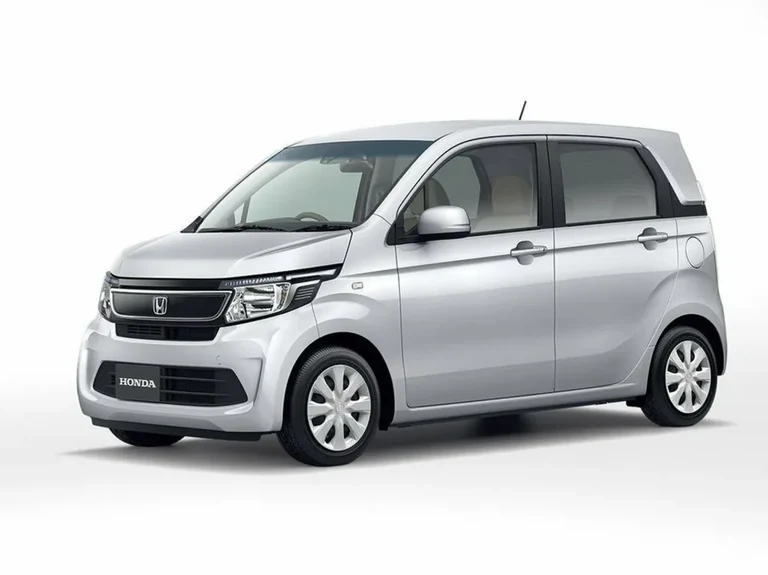
The N-WGN appeared in November 2013 as the fourth model of the N series – after the N-BOX, N-BOX+ and N-ONE. The idea was simple: take the N-BOX platform with a central tank and make on it not a “box” with sliding doors, but a lower and lighter hatchback for those who are more interested in economy and a regular seat. According to Honda’s archival specifications, the first N-WGN has a length of 3395 mm and a width of 1475 mm – the standard limits of the key-class – a height of 1655 mm for front-wheel drive and 1675 mm for all-wheel drive versions, a wheelbase of 2520 mm, a ground clearance of 150 mm and a weight of 820 to 900 kg. The 0.658-liter S07A engine develops 58 hp at 7300 rpm naturally aspirated and 64 hp at 6000 rpm with a turbine; consumption according to the Japanese JC08 cycle in the naturally aspirated front-wheel drive version is declared at 29.2 km/l, in the turbocharged version – 26.0 km/l. Wheels in all versions at the start are 155/65R14, and the turbo version has ventilated brake discs in the front.
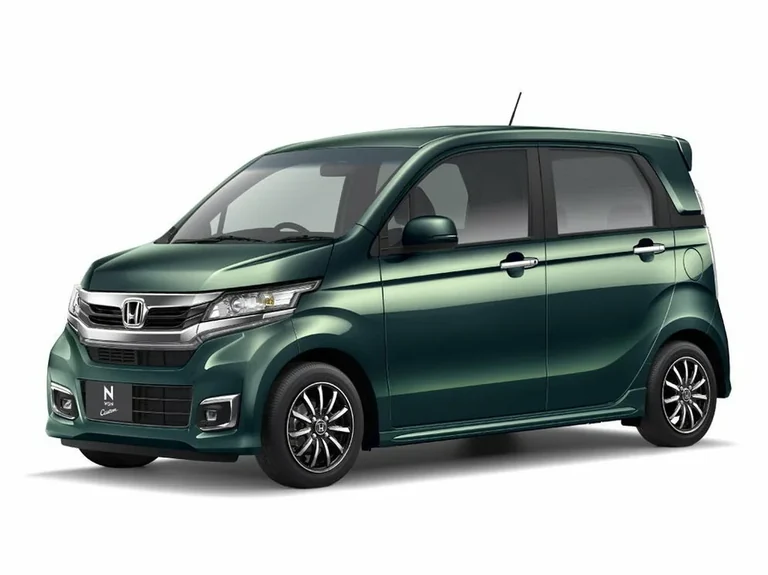
The first trim levels were called G, G· A Package and G· Turbo Package, and each had a double with the Custom prefix. In the spring of 2015, the line was reshuffled: the basic C, the G· L Package and Stylish Package appeared, and the Turbo Package remained turbocharged. In June 2016, the first N-WGN was updated: the car received new LED headlights and grille with chrome trim or body color, the Custom had a new aerodynamic body kit, two-tone trim options and a new front fascia appeared in the cabin. At the same time, the body code did not change: the updated cars of 2016-2019 remain JH1 and JH2. It was during this period that special editions appeared, whose names are now found on auction lists: SS Package II, SS Black Style Package and SS 2-Tone Color Style Package for Custom, including in combination with a turbo engine – for example, Custom G· Turbo SS Black Style Package.
The first generation has an important caveat when it comes to safety. Honda SENSING, the driver assistance system that became standard in the second generation, was not offered on the JH1/JH2. According to Honda’s archive page for 2016-2019 cars, it was a factory option as part of the Ansin package (安心パッケージ), so two seemingly identical N-WGNs of the same year may not have it or may have it. In the first generation, the N-WGN has already received an ASV+ rating from the 2015 Japanese Preventive Safety Assessment Program, but this is an assessment of a specific version with the system installed, not the entire line. All first-generation versions are collected on pages 2013-2016 and 2016-2019.
JH3 and JH4, from 2019: new platform, Honda SENSING and two updates
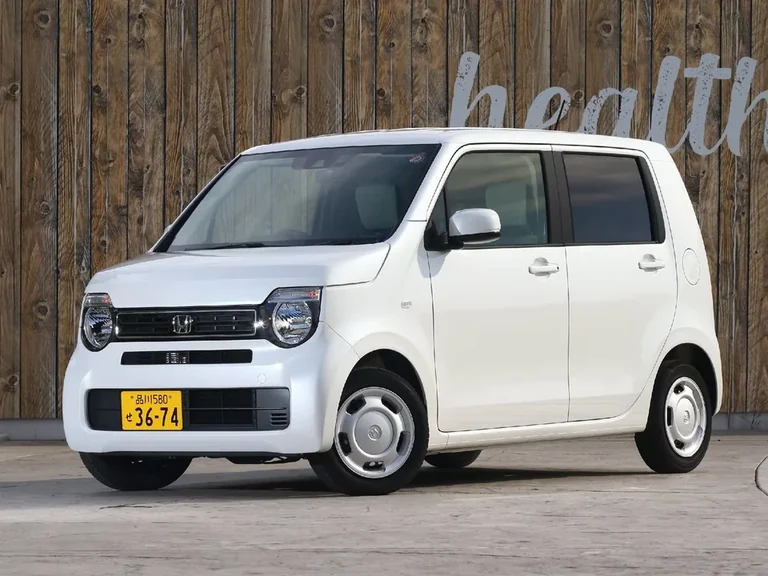
Honda introduced the second generation on July 18, 2019, sales began on August 9. The car remained in the same dimensions – 3395 by 1475 mm with a base of 2520 mm – but received a new second-generation N-BOX platform, a body in which 64 percent of high-strength steels are made, and a new S07B engine. The height has increased to 1675-1725 mm, depending on the version, the ground clearance has decreased to 140-145 mm, the weight – from 850 to 930 kg. There is a footnote in the release: for some types without a turbo engine, a specification without Honda SENSING was offered, so for cars of 2019-2022, the presence of the complex should be checked against the sheet, and not taken for granted. At the same time, the N-WGN was the first among Honda kei cars to receive a steering column with offset adjustment and standard rear parking sensors, and with them an electronic handbrake and an automatic brake hold function.
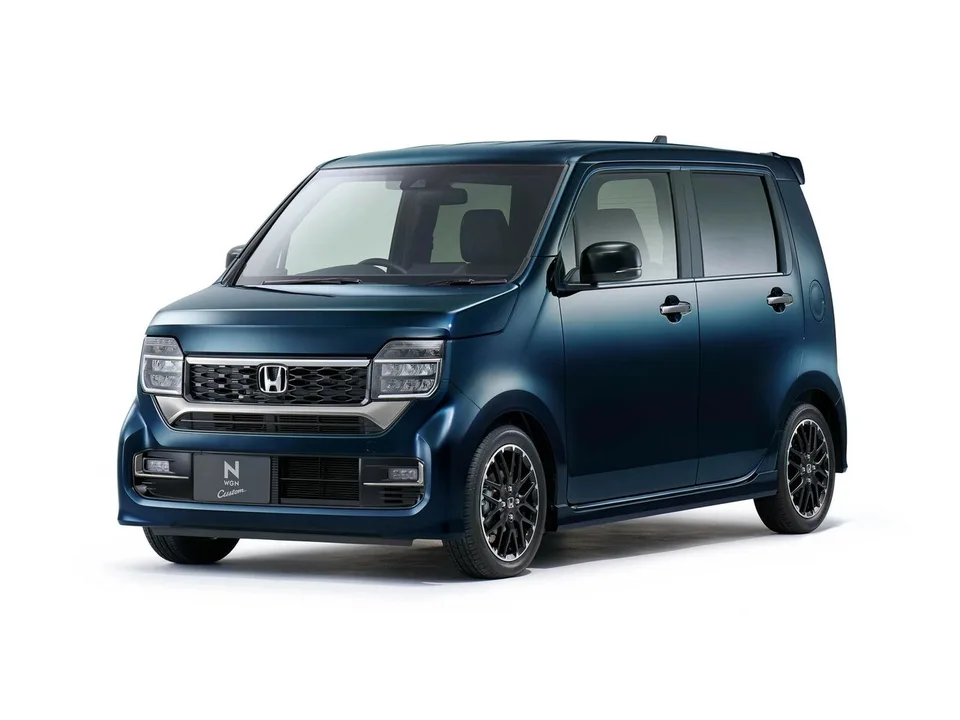
The design of the two versions was separated more than before. The base N-WGN received round headlights and calm body planes – Honda describes it as a car that should fit into everyday life; N-WGN Custom – emphatically massive bumpers, finely designed headlights and grille, black interior with titanium trim versus brown with beige seats in the base version. At the start, each had three trim levels: G, L and L·Turbo, plus a version with a swivel passenger seat at the base N-WGN. Release prices range from 1,274,400 to 1,793,880 yen with a tax of 8 percent. An example of a turbocharged version in the catalog is the Custom L·Turbo Honda SENSING; All cars of 2019-2022 are on the page of the second generation.
The first update of the second generation took place in September 2022 – this is how the Honda archive dates it, in the catalog this part of the lineup is counted from July. The Custom has a new grille with dark silver edging and a black glossy mesh, the Honda SENSING has received an acceleration suppression function with tangled pedals, and a special Style + Bitter series with chrome details and its own seat trim has been added to the lineup. Nothing has changed in terms of technology, but only the Custom L·Turbo has remained the turbo engine since then – the base N-WGN no longer has a version with a turbine. The second, small update was released on September 25, 2025: parking sensors were added to the front, short-range auto braking appeared in the Honda SENSING, the dashboard became a seven-inch screen, the base N-WGN had an L Fashion Style version with mirrors and handles in off-white color, and the Custom had a special BLACK STYLE series with black grille pads, emblems and wheels. Prices for the 2025 release range from 1,576,300 yen for the L with front-wheel drive to 2,124,100 for the Custom L·Turbo BLACK STYLE with full-wheel drive. All cars after the 2022 update are collected on the second-generation page after the update.
Custom is not a generation: how it differs and how to recognize it
The word Custom has been in the name of the N-WGN from the very beginning and does not denote the level of equipment, but a parallel version with a different appearance: its own front and rear bumpers, radiator grille, headlights and a different character of the interior. The body code of the Custom is the same as that of the base car of the same year and the drive – JH1 or JH3 for front-wheel drive, JH2 or JH4 for all-wheel drive – so they cannot be distinguished by the code. You can distinguish them by three things. The first is the front: the base of the first generation has a compact grille, with an emblem on a dark background, the Custom of 2013-2019 is wide, in a chrome frame, with a large mesh; the base second generation has round headlights, while the Custom has rectangular headlights, with a massive black grille between them and a heavy lower bumper. The second is the emblem: the Custom has a separate CUSTOM nameplate, which a regular car does not have – the first generation has it on the front bumper, and in the second generation BLACK STYLE series it is painted black. The third is documents: in the auction sheet and in the catalog, the name of the version begins with the word Custom, followed by the usual letter of the configuration – G, L or L·Turbo.
Inside, the difference is also noticeable: in the second generation of the Custom release, Honda received a black interior with glossy titanium inserts, the base car received a brown front fascia and light seats. In terms of technology, the Custom does not differ from the base version of the same year: the same 58 or 64 hp, the same CVT, the same choice of drive. The only technical link appeared after the 2022 update – the turbo engine has since been available only in the Custom L·Turbo, so any turbocharged N-WGN of 2022 and younger is Custom by definition. The opposite is not true: most Custom at auctions are naturally aspirated G and L.
Turbo, 4WD and version names
The name of the version in the sheet is made up of several words, and each means a different car with the same body code. Turbo Package in the first generation and L·Turbo in the second generation are 64 hp and 104 Nm instead of 58 hp and 65 Nm; in the first generation, the turbocharged versions at the start were on the same 14-inch 155/65R14 wheels as the rest, and in the second, according to the specification, Honda received the 165/55R15 and paddle shifters for virtual CVT gears. The owner could change the wheels, but the paddles on the steering wheel of the second generation and ventilated front discs of the first generation did not, so it is worth looking for them in the photos of the lot, And not the size of the tyres. The prefix 4WD in the name always coincides with the even code JH2 or JH4 and adds from 130 to 145 thousand yen to the price of a new car; the all-wheel drive naturally aspirated version of the first generation according to the Honda specification has a worse consumption on the JC08 – 26.0 instead of 29.2 km/l – and a different rear suspension. The letters G, L and C indicate the level of equipment, the “packages” of the first generation – A Package, SS Comfort, SS Package II, Black Style, 2-Tone Color Style – factory sets of options and finishes, Style + Bitter and Fashion Style – special series of the second generation. All of this is listed on page G· Turbo Package of the first generation and on adjacent pages of versions, where each has a body code, drive, tyres and production period.
What to check before buying
First, the body code and the year in the auction sheet must match each other and what is visible in the photos: JH1/JH2 – 2013-2019, JH3/JH4 – from August 2019; for the first generation, new LED headlights and grille mean a car after June 2016, for the second – a new Custom grille – after the fall of 2022, and front parking sensors and a seven-inch dashboard – after September 2025. Then – the name of the version: Custom, Turbo, 4WD and the package mean different cars with the same code. For the first generation, it’s worth making sure that the City Brake Active System is actually installed: it was an option, and in the auction photos, it is given away by the sensor at the top of the windshield near the mirror. For the second generation of 2019-2022 – that Honda SENSING was not filmed by order of the first owner, such a specification existed for some atmospheric versions. Consumption of 29 km/l according to the JC08 refers to the front-wheel drive naturally aspirated version of the first generation, the second according to the stricter WLTC cycle is declared about 23 km/l for the base L – in practice, the difference with an all-wheel drive and turbocharged car will be more noticeable. How to read the estimates in the list is explained on the page about the decoding of the auction sheet; what GTYRES looks at the lot before the bid is described in a separate article; other kei cars are collected in the catalog selection, and the cost with delivery for a 0.66-liter engine is calculated in the calculator – the engine capacity and date of manufacture are included in the calculation directly.