Suzuki Jimny, Jimny Sierra and Nomade: differences in body code
The Suzuki Jimny has been produced since April 1970, and two different cars have long lived under this name in Japan. The first is a kei car: a narrow body with a width of 1,475 mm, a 0.66-liter engine with a turbine and a capacity of 64 hp, but Japanese kei-class benefits and the smallest volume for calculating the duty. The second is a “big” Jimny with arch extensions, a 1.3-liter, and now a 1.5-liter engine, which in 1998-2002 was called the Jimny Wide, and since January 2002 – the Jimny Sierra; it is exported simply as the Jimny. Since April 2025, a third has been added to them – the five-door Jimny Nomade, for which about 50 thousand orders have been collected in Japan in four days. The steel panels are all the same, so it is easy to confuse the versions in the ads, and the difference between them is in the engine, width, price and how the car is cleared at customs. The most reliable way to distinguish them is by the body code: JB23 and JB64 are kei versions, JB33, JB43 and JB74 are wide, and JC74 is five-door. In the GTYRES catalog, there are three separate routes – Jimny, Jimny Sierra and Jimny Wide – and below is an explanation of what is behind each Suzuki release code.
Why Jimny has three pages of catalog
The catalog repeats the Japanese practice: the Jimny kei car and the Jimny Sierra subcompact car are registered as different classes of cars, they have different numbers (yellow for the kei car, white for Sierra) and different taxes, although they are built on the same assembly line. The body code reads like this: two letters – family, numbers – generation and dimension. For kei versions, these are JB23W (1998-2018) and JB64W (from 2018), for wide versions – JB33W (Jimny Wide 1998-2000 with a G13B engine), JB43W (Wide from 2000 and Sierra 2002-2018 with an M13A engine) and JB74W (Sierra from 2018), for a five-door – JC74W. The older kei versions in the catalog are coded JA71, JA11, JA12 and JA22 (1986-1998), and the first Jimny Sierra from 1993-1998 bore the codes JB31W and JB32W: it was a Jimny 1300 with a 1.3-liter engine with 70 hp. and springs, which at the end of 1995 received a 16-valve G13B with 85 hp. and springs. How Japanese codes work in general is described in the article on body code.
JB23, 1998–2018: twenty years of one body
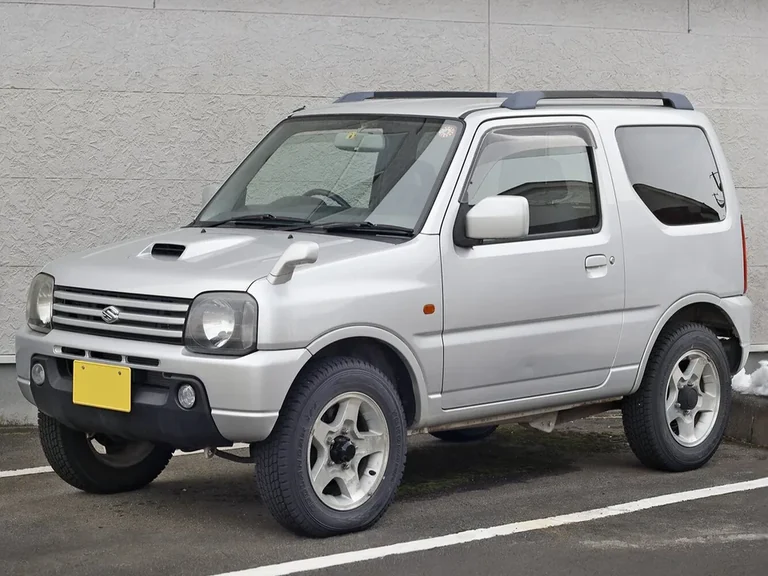
The third Jimny was released on October 7, 1998 along with the new Alto, Wagon R and Kei – Suzuki at once updated the entire lineup to the new Kei-class standard, which, with the previous 660 cc, allowed bodies longer by 100 mm and wider by 80 mm for safety in the event of an impact. The turning radius of the Jimny is 4.8 m. The car received a new ladder frame, continuous spring-loaded axles front and rear, a plug-in all-wheel drive with a reduction gear – a transfer case lever with positions 2H, 4H and 4L, where the front axle is connected on the move up to 100 km / h – and a three-cylinder turbo engine with an intercooler for 64 hp. with a 5-speed manual or a 4-speed automatic transmission. XA, XL and XC trim levels, special versions like KANSAI by designer Kansai Yamamoto, and in 2000-2001 even rear-wheel drive Jimny L and Jimny J2 without a front axle – they were produced for a short time and were removed after an update. On January 21, 2002, the Jimny received a new hood and grille with wide horizontal bars, a larger intercooler and more traction on the bottom; on October 13, 2004, the transfer case lever gave way to Drive Action 4×4 buttons on the panel, a new dashboard and a black grille appeared. Dimensions – 3,395 × 1,475 × 1,715 mm with a base of 2,250 mm. Catalog entries: Jimny 1998-2001, 2002-2012, code JB23W.
On May 14, 2012, the last major update of the JB23 took place: the hood was changed to protect pedestrians, ISOFIX fasteners were added to the rear sofa, and at the same time another special version of the X-Adventure with a chrome grille and red stitching in the cabin was released. In August 2014, the instruments and upholstery were changed and the Land Venture was released with gold inserts. All this is the same JB23W code and one 64 hp engine, so when choosing within a twenty-year production, the year and condition are more important than the “type” number in the ad: consumption for the late JB23 is 14.8-16.4 km/l. Catalog entry – Jimny 2012-2018.
Jimny Wide and Jimny Sierra JB33 and JB43, 1998–2018
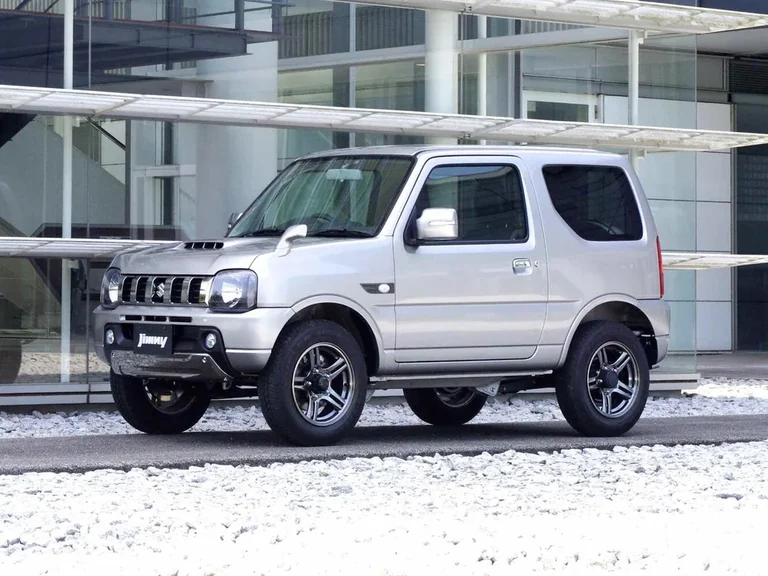
A third-generation wide version appeared in January 1998 under the name Jimny Wide: the same interior and the same panels, but different bumpers, arch extensions and tracks, a 3,550 × 1,600 mm body and a 1.3-liter four-cylinder G13B with 85 hp. according to catalog data – without an air intake on the hood, because there is no turbine here. On April 13, 2000, Suzuki replaced the engine with a new M13A – 1.3 L, DOHC, 16 valves, variable VVT phases, according to catalog data 88 hp. and 118 Nm – and this engine survived until 2018; the body code changed from JB33W to JB43W. On January 21, 2002, the car was renamed the Jimny Sierra, adding heated folding mirrors and new upholstery, the price was 1,515,000 yen with a manual and 1,613,000 with an automatic transmission. Then the Sierra was updated synchronously with the kei version: Drive Action 4×4 buttons and a new panel in October 2004, a new hood and ISOFIX in May 2012, and in August 2014, the Sierra, unlike the kei version, received an ESP stabilization system and traction control as standard. The turning radius of the wide version is 4.9 m instead of 4.8. Catalog entries: Jimny Wide 1998–2002 and code JB33W; Jimny Sierra 2002–2012, 2012–2018 and code JB43W. There are no photos of Japanese Jimny Wide and Sierra of these years in the catalog library, so the section remains without illustration: export Jimny 1.3 with European license plates look the same, but these are different cars.
JB64 and JB74, from 2018: first full shift in twenty years
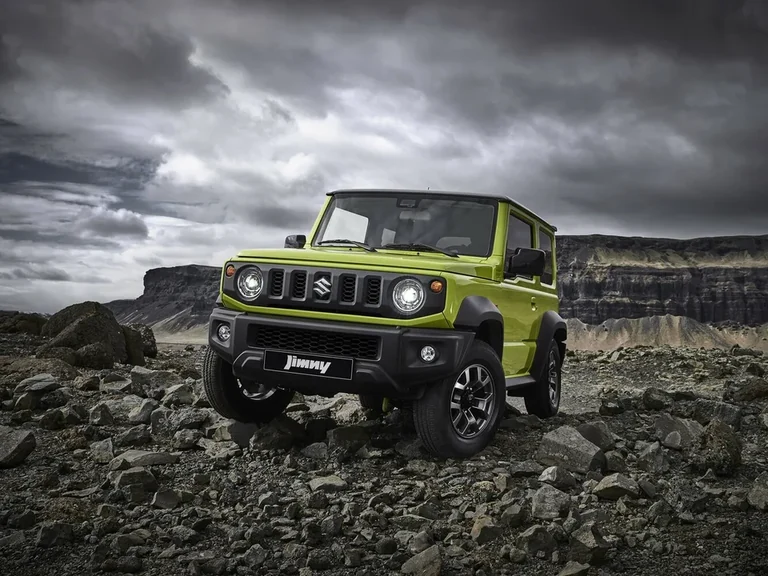
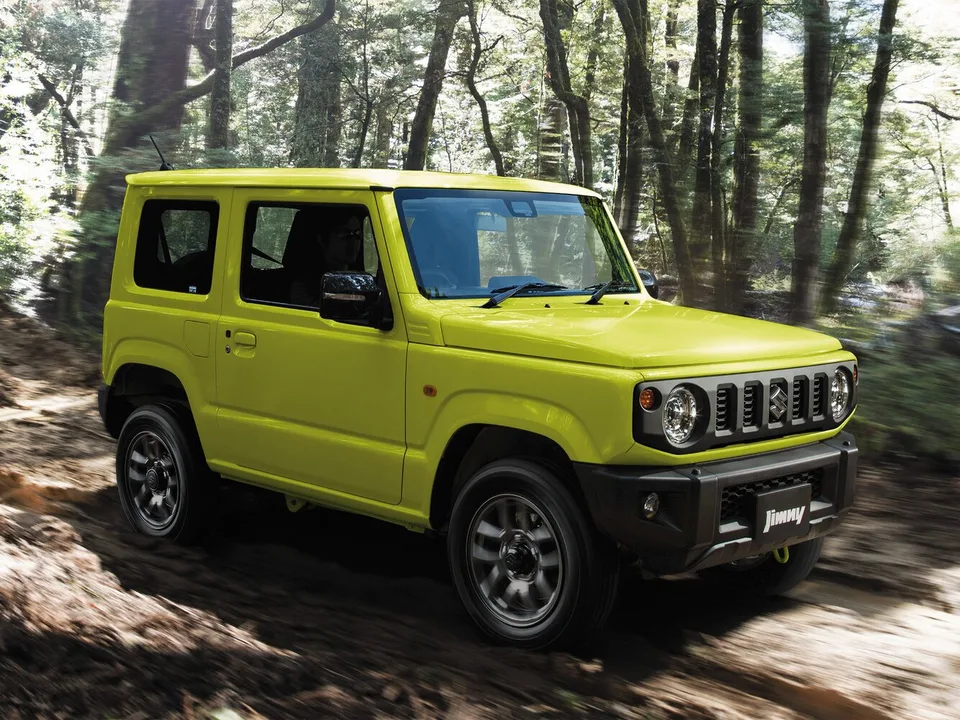
On July 5, 2018, for the first time in twenty years, Suzuki completely replaced the Jimny and Jimny Sierra, retaining everything the model is loved for: the ladder frame (new, with torsional stiffness about one and a half times higher), the longitudinal motor and rear-wheel drive at the core, plug-in all-wheel drive with mechanical reduction gear – 4L gives about twice the tractive effort – and continuous axles on three levers. New – electronic imitation of Brake LSD locks on all versions, assistance when starting uphill and downhill, steering damper. The Kei version received a specially tuned R06A turbo engine – according to catalog data, 658 cc, 64 hp. at 6,000 rpm and 96 Nm at 3,500 – and the Sierra – a new 1.5-liter K15B with 102 hp. and 130 Nm, while the Sierra body became 50 mm shorter and 45 mm wider than its predecessor. Both are with a 5-speed manual or a 4-speed automatic transmission; WLTC consumption at the start is 16.2 and 13.2 km/l for the kei version, 15.0 and 13.6 for the Sierra. Trim levels: XG, XL and XC for the Jimny, JL and JC for Sierra, starting prices from 1,458,000 to 1,841,400 yen and from 1,760,400 to 2,019,600. What you should know when choosing cars for 2018-2025: the Suzuki Safety Support complex with auto-braking by camera and laser was standard only for the XC and JC, and on the XG, XL and JL it was a factory option for 42,120 yen, so its availability is checked by sheet, not by year. For the first time, both models are assembled at the plant in Kosai and from there shipped around the world. According to the catalogue data, the dimensions are 3,395 × 1,475 × 1,725 mm for the Jimny and 3,550 × 1,645 × 1,730 for the Sierra with a total base of 2,250 mm. Directory entries: Jimny from 2018 and code JB64W, Jimny Sierra from 2018 and code JB74W.
Then the generation changed in small steps, and it is convenient to date the car by them. From October 20, 2021, versions without Safety Support also received automatic light on, and the automatic received a start-stop system – it works only in 2WD mode; from July 20, 2022, the same system appeared in the mechanics. From April 11, 2024, there were changes to the new norms and a rise in price: the kei version already cost 1,654,400-2,002,000 yen, the Sierra – 1,962,400-2,183,500. The most notable update was released on November 4, 2025: second-generation Dual Sensor Brake Support II, lane keeping is standard on all versions, adaptive cruise with operation to a complete stop at the automatic, protection against erroneous reverse start and Suzuki Connect telematics with a 9-inch display for an additional fee; prices range from 1,918,400 yen for the XG to 2,385,900 for the Sierra JC. So the Jimny with adaptive cruise to a complete stop and lane keeping is a car no earlier than the end of 2025; the XC and JC had conventional cruise control before.
Jimny Nomade JC74: five-door, from 2025

The five-door Jimny did not first appear in Japan: on January 12, 2023, Maruti Suzuki showed it at the Auto Expo in Delhi – 3,985 × 1,645 × 1,720 mm with a base of 2,590 mm, 1.5 liter engine, manual or automatic transmission – and since then it has been produced in India for the local market and for export to Africa and Latin America. The Japanese version, called Jimny Nomade, was introduced on January 30, 2025 and went on sale on April 3, 2025 – the first five-door in the history of the series, a four-seater, with a single FC trim level. Compared to the Sierra, the base is longer by 340 mm, the rear seats are pushed back by 50 mm and raised by 20 mm, the distance between the rows has increased by 90 mm, and the trunk floor with four passengers has increased by 350 mm; the frame for the Nomade has been remade taking into account the increased weight, and the drive, axles and downshift are the same. As standard, there is dual-camera autobraking, the automatic also has adaptive cruise; WLTC consumption is 14.9 km/l with manual and 13.6 with automatic, the price is 2,651,000 and 2,750,000 yen. The grille of the Nomade is painted in the color “gun metal” with chrome edging, and not black, as in Sierra. According to catalog data, the Japanese Nomade is 3,890 × 1,645 × 1,725 mm, the trunk is 211 liters, the clearance is 210 mm. Demand exceeded every plan: on February 3, 2025 Suzuki stopped taking orders, having collected about 50 thousand against a plan of 1,200 cars per month, from July 2025 it raised output in India to about 3,300 per month, and reopened orders only on January 30, 2026 – by lottery among applications submitted before February 28. At the same time, an updated version was announced with Dual Sensor Brake Support II, Lane Keep, Color Display and Suzuki Connect, a seventh Granite Grey color and a price of 2,926,000 yen; sales from July 1, 2026. According to published estimates, the collected orders stretched over about three and a half years of production. Catalog entry – Jimny Nomade from 2025, code JC74W.
What to check before buying
The first is which of the three cars is in front of you: the kei version has no arch extensions, a yellow number and 0.66 liters in the documents, Sierra has expanders, a white number and 1.3 or 1.5 liters, and Nomade has five doors. The engine size directly affects the calculation in the Duties and taxes, and the power of all versions fits into the catalog filter up to 160 hp. Secondly, the year and the code must match: JB23W and JB43W – until 2018, JB64W and JB74W – from July 2018, JC74W – from 2025. The third is equipment by sheet, not by year: the 2018-2025 versions of the XG, XL and JL could not have Safety Support, “start-stop” appeared in 2021-2022, adaptive cruise to stop and lane keeping – only from November 2025. The fourth is the condition: Jimny is bought for off-road and modified, and many old cars have been in the hands of “craftsmen”, and authentic copies are increasingly difficult to find, so in the auction sheet it is worth looking for traces of suspension lift, non-standard wheels, winches and rust on the frame, and repairs and replacements should be reflected in the description of the lot. How GTYRES checks the lot before bidding is in a separate article, how to read the sheet on the page about deciphering the auction sheet, and other all-wheel drive cars are collected on the page about all-wheel drive from Japan.