Toyota Alphard: generations, engines and hybrids by body code
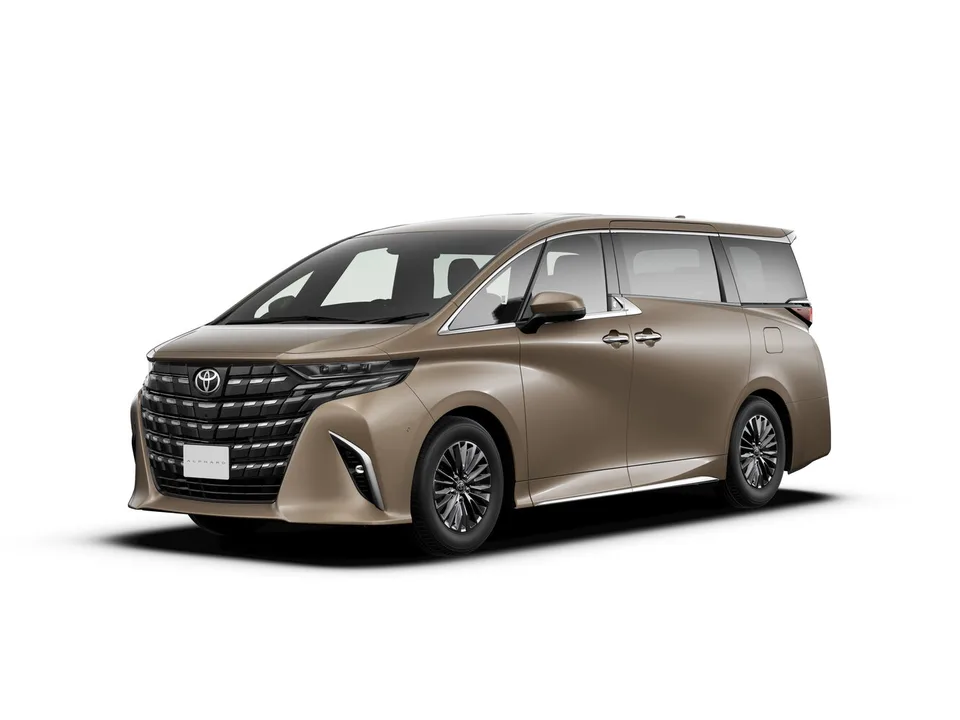
The Toyota Alphard has been sold in Japan since May 2002 as the brand’s flagship minivan, and during this time four generations have changed: H10 (2002-2008), H20 (2008-2015), H30 (2015-2023) and the current H40, from June 2023. For the buyer, it is not the generation number that is more important, but what is hidden in the body code: the first letters are called the engine – 2.4 liters, 3.0 liters, 3.5 liters V6, 2.5 liters or hybrid – and the drive must be checked against the full code: for example, ANH10W is front, ANH15W is full. The hybrid Alphard existed almost all the time, except for the first three and a half years of the second generation, and always came only with the E-Four electric all-wheel drive – until 2023, when the front-wheel drive hybrid first appeared. Below are what changed by Toyota releases, what engines and gearboxes were in each generation, how the aerodynamic versions differ from the regular ones and what to look at in the ad. All generations and codes are collected in the Alphard catalog, and the twin brother Vellfire, which has been sold since 2008 through another dealer network, is in its own section.
How to Read Alphard Body Code
Toyota’s body code consists of engine letters, generation numbers, and body letter W for station wagons and minivans. For the Alphard, it looks like this: ANH is a 2.4 liter 2AZ-FE petrol car, MHN is a 3.0 liter V6 1MZ-FE, ATH is a 2.4 liter hybrid, GGH is a 3.5 liter V6 2GR, AGH is a 2.5 liter 2AR-FE hybrid, AYH is a 2.5 liter hybrid of the current generation A25A-FXS, AAHP is a plug-in hybrid. The numbers 10, 20, 30 and 40 are the generation, and the replacement of zero with five is all-wheel drive: ANH10W front-wheel drive, ANH15W all-wheel drive, AGH30W and AGH35W, GGH20W and GGH25W, and so on. The hybrids of the first three generations are all-wheel drive in design, so they have only “zero” codes – ATH10W, ATH20W, AYH30W – and the current hybrid has both front-wheel drive AAHH40W and AAHH45W with the E-Four. In the catalog, each code has its own page, for example, ANH10W, GGH30W or AAHH40W, and the general principle of Japanese codes is discussed in the article on body code.
H10, 2002–2008: Alphard G, Alphard V and the first hybrid
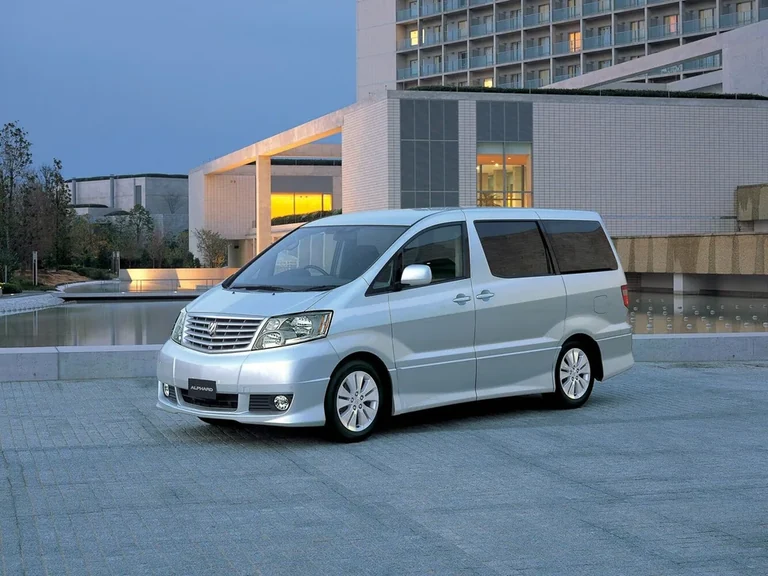
The first Alphard was released on May 22, 2002 in two versions at once: the Alphard G was sold by Toyopet dealers, the Alphard V was sold by the Toyota Vista network, and they differed in grille and trim details. The body of 4,800 mm long, 1,805 wide and 1,935 high on the basis of 2,900 mm (MS and AS airversions – 4,845 and 1,830 mm) accommodated an interior of 3,085 × 1,585 × 1,390 mm, which Toyota considered the largest among Japanese minivans; there are seven seats (2 + 2 + 3) or eight (2 + 3 + 3), the electric tailgate is the first in Japan, but only on the upper versions. There are two engines: an in-line “four” 2AZ-FE with a volume of 2.4 liters at 117 kW (159 hp) and V6 1MZ-FE at 3.0 liters and 162 kW (220 hp), both with a 4-speed Super ECT automatic transmission, front or permanent all-wheel drive with viscous coupling. The platform is front-wheel drive – McPherson struts at the front and a torsion beam at the rear, expensive versions have TEMS suspension with adjustable shock absorbers. On July 30, 2003, the Alphard Hybrid was added: THS-C system with 2.4-liter 2AZ-FXE, Super CVT CVT and E-Four rear electric motor, 17.2 km/l on a 10·15 cycle versus 8.6 for the three-liter, plus a 100 V and 1,500 W outlet – then it was news. An update on April 19, 2005 brought new bumpers, grilles and lights, a 5-speed automatic transmission for the V6, hard disk navigation and G-BOOK ALPHA telematics; Alphard V has since sold the Netz network. Directory entries: Alphard 2002–2005 and after the 2005 update; codes ANH10W and ANH15W (2.4 L), MNH10W and MNH15W (3.0 L), ATH10W (hybrid).
H20, 2008–2015: Vellfire’s emergence and the return of the hybrid
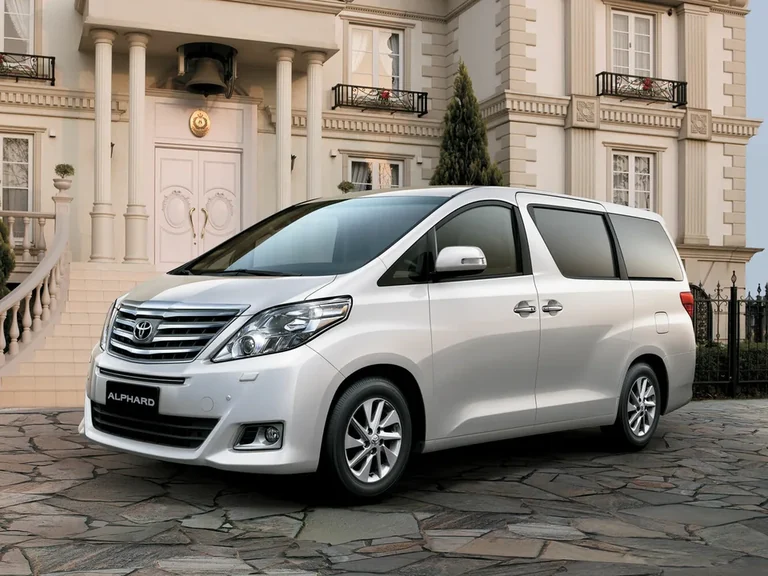
On May 12, 2008, Toyota changed the generation and divided the model into two: the Alphard remained with Toyopet, and the Vellfire appeared for the Netz network – the same car with a different front end and a more “aggressive” character. The new platform lowered the floor by 55 mm, due to which, with a lower roof, the cabin became 10 mm higher and 75 mm longer; according to catalog data, the body grew to 4,840-4,855 mm with a width of 1,830-1,840, and the base – to 2,950 mm. Both engines changed: instead of 3.0 liters, a 3.5-liter V6 2GR-FE with a dual VVT-i and a 6-speed automatic transmission was installed, the 2.4-liter 2AZ-FE received a Super CVT-i CVT; according to catalog data, these are 280 hp with 344 Nm and 170 hp with 224 Nm, and the consumption of the 2.4 liters with front-wheel drive Toyota declared 11.6 km/l – about 20% better than its predecessor. The standard included seven airbags and the S-VSC stabilization system with steering, the “Executive Power Seat” with electric drive and footrests appeared on the second row, and the audio system received 18 speakers. This is the THS II with a gearbox on the same 2.4-liter 2AZ-FXE and E-Four, 19.0 km/l on the cycle of 10·15 and 17.0 on the JC08; at the same time, the Alphard was the first Toyota to receive a panoramic monitor with a top view. It was the updated H20 that became the first Alphard that was officially sold in Russia – from September 2011 to February 2015, but these are left-hand drive cars of a different specification, and they should not be mixed with Japanese right-hand drive. Catalog entries: Alphard 2008–2011 and 2011–2015; codes ANH20W and ANH25W (2.4 L), GGH20W and GGH25W (3.5 L), ATH20W (hybrid).
H30, 2015–2023: “Large saloon saloon”, Executive Lounge and 8-speed automatic transmission
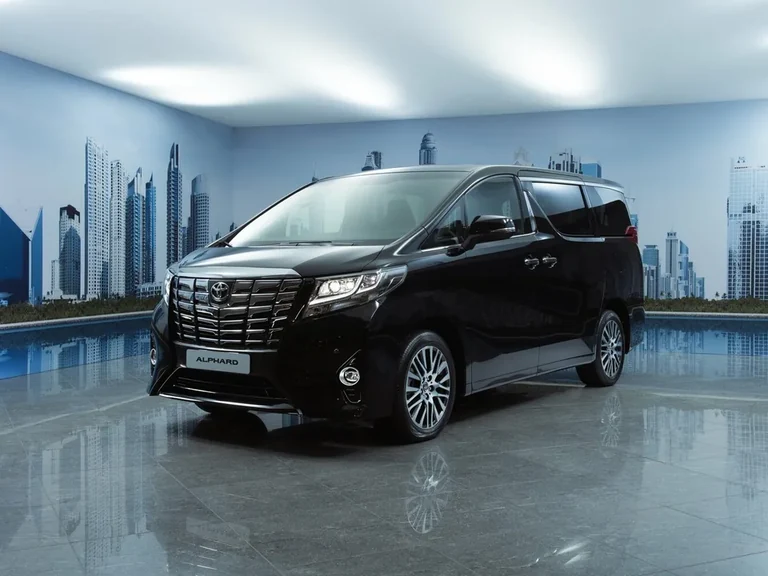
The third generation went on sale on January 26, 2015 under the slogan “large luxury interior”: Toyota wanted driving qualities at the level of an executive sedan, so for the first time an independent suspension on double wishbones appeared at the rear, the body became stiffer due to adhesive joints and high-strength steels, and the floor was lowered even lower – a height of 1,880 mm with the previous 1,400 mm cabin height and a footrest 50 mm lower. Under the third row there was a niche for 148 liters, the front passenger seat received a stroke of 1,160 mm to the rear row, and on top of the line stood the Executive Lounge version with the seats of the second row wider by 100 mm. Engines are again three, but different: 2.5-liter 2AR-FE with a CVT and 7 virtual stages (12.8 km / l according to JC08 with the ordered start-stop option), the 2AR-FXE hybrid on the Atkinson cycle with the E-Four (19.4 km/l) and the former 3.5-liter 2GR-FE with a 6-speed automatic transmission (9.5 km/l). According to the catalogue data, the length has increased to 4,915–4,950 mm with a width of 1,850, the base to 3,000 mm, and the interior to 3,210 × 1,590 × 1,400 mm. Catalog entries: Alphard 2015–2017; codes AGH30W and AGH35W (2.5 l), GGH30W and GGH35W (3.5 l), AYH30W (hybrid).
The update was announced on December 25, 2017, and sales began on January 8, 2018. Externally, this is a different front end with a huge grille to the very bottom of the bumper, but the main thing is the technology: the second-generation Toyota Safety Sense complex has become standard on all versions and has learned to see cyclists during the day and pedestrians at night, LTA lane tracking and blind spot monitors have appeared, and the V6 has been replaced by 2GR-FKS with an 8-speed Direct Shift-8AT automatic transmission – according to catalog data, 301 hp. and 10.4-10.8 km/l instead of 9.1-9.5 for the previous one. An airplane version of the Executive Lounge S with a black and white interior appeared. Further by year: from October 25, 2018, Intelligent Clearance Sonar sonars are standard on all versions, from December 2019 – an audio display with a smartphone connection, in April 2021 there was another improvement. Catalog entry – Alphard 2018-2023. The body after updating according to catalog data is 4,955 mm long with a height of 1,935 (2WD) or 1,950 (4WD). The same H30 in both guises was officially sold in Russia – from January 2015 to December 2022 – and the same clause about different specifications applies here.

H40, from 2023: TNGA platform, front-wheel drive hybrid and PHEV
The current Alphard has been on sale since June 21, 2023. The TNGA GA-K platform, modified for the minivan, gave the body 50% more rigidity, and vibrations reaching passengers, according to Toyota, have been reduced by about three times; some versions have shock absorbers that respond to the frequency of bumps. The size was deliberately kept within the limits of a typical mechanized parking lot – no more than 5,000 × 1,850 mm: according to catalog data, it is 4,995 × 1,850 × 1,935 mm with a base of 3,000 mm. The basis of the line is a hybrid on the 2.5-liter A25A-FXS with a total output of 184 kW (250 hp), 17.5 km/l for the front-wheel drive version of the Executive Lounge and 16.5 for the E-Four; for the first time, the hybrid Alphard can be taken with front-wheel drive. The petrol version of the X is the former 2.5-liter 2AR-FE with a CVT, and the 2.4-liter T24A-FTS turbo engine with an 8-speed Toyota automatic transmission left only the Vellfire in the Z Premier version. Alphard versions are X, Z and Executive Lounge, prices at the start range from 5,400,000 to 8,720,000 yen. For passengers, a long ceiling console with common buttons and lighting, retractable On December 20, 2024, a plug-in hybrid was announced: a six-seater, with an electric range of 73 km according to WLTC, with a total output of 225 kW (306 hp), fast charging in about 38 minutes to 80% and a 1,500 W outlet; sales of the PHEV began on January 31, 2025, and from January 7, 2025, the regular versions received a digital interior mirror with a dashcam as standard and an eight-seater hybrid X. Last improvement on June 3, 2026. codes AGH40W and AGH45W (2.5 L petrol), AAHH40W and AAHH45W (hybrid), AAHP45W (PHEV, E-Four only).
Aeroversions, Executive Lounge and other traps of names
In each generation, the Alphard is divided into a “standard” and “aero” body: in the H10, these are the MS and AS versions with different bumpers, trims and 17-inch wheels, in the H20 – the S version with 18-inch wheels, in the H30 – the Aero Body with more aggressive air intakes, for which the TRD and Modellista packages were offered. The first-generation Aeroversion is 45 mm longer and 25 mm wider than the regular ones; they are more expensive, and should not be confused with the Vellfire: the Vellfire is a separate model with its own front end, and in the fourth generation also with its own turbo engine. Since 2015, the Executive Lounge has not been an aeropackage, but an upper version with separate wide second-row seats, and in ads it is noticeably more expensive than the usual seven- and eight-seaters. The word Hybrid in the first three generations automatically means E-Four all-wheel drive, in the H40 it is no longer there, where the drive is read by the code AAHH40W or AAHH45W. Finally, all generations have low ground clearance – it is called a significant drawback of the H10 to H30 model – which should be taken into account when choosing winter tires and a route.
What to check before buying
The first is the engine size: 2.4 and 2.5 liters, 3.0 and 3.5 liters and a hybrid give different figures in the Duties and taxes, and the catalog has a separate filter for versions up to 160 hp, which includes versions with an engine up to 160 hp – for example, 2.4 liters of the first generation and 2.5 liters, but not 2.4 liters of the second generation with 170 hp. and not V6. Secondly, a hybrid needs a report on the state of the battery and an understanding of how its power is calculated: a separate article about the power of a hybrid from Japan is about this. The third is the complete set: the H30 before the 2018 model year update, the Toyota Safety Sense complex was not standard, and preventive braking, a panoramic monitor and a radar cruise came for an additional fee, and the Executive Lounge differs in seats, not just a nameplate. The fourth is the year and code: the H30 with the code AGH30W can have a car from 2015 or 2022, and the difference between them is in the front and V6 automatic, so the release date should be checked with the photos, and the same rule applies to Japanese and Russian copies of the same generation, which is more about in the article about the generation and the market. What GTYRES checks for the lot before bidding is described in a separate article, and other hybrids and family cars are collected on the pages about hybrids and family cars from Japan.