Honda Freed: which generation to choose for the family and what to check by body code
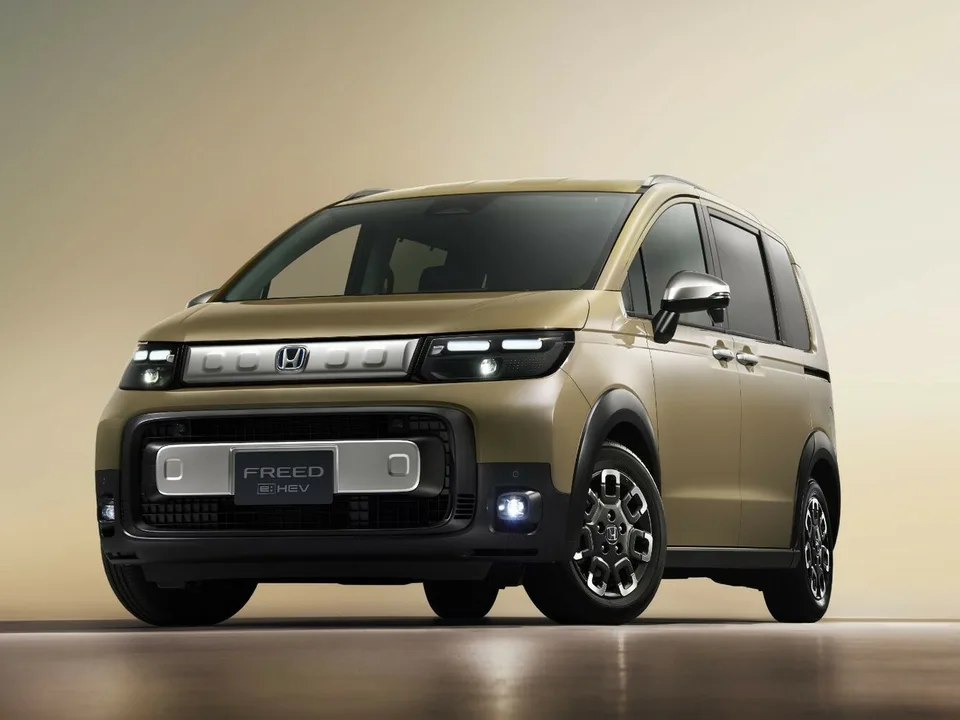
Freed has been sold in Japan since May 30, 2008 and during this time it has changed three generations, and the word “Hybrid” on its body managed to mean three different installations: an assistant electric motor with a petrol engine, a robot with two clutches and a dual-motor system in which the car is carried by an electric motor. At the same time, the idea itself did not change: a compact minivan with a width of 1,695 mm with a low floor, sliding doors and three rows of seats, which fits in a tight parking lot and turns in 5.2 m.
What all three generations have in common
The wheelbase of 2,740 mm and the minimum turning radius of 5.2 m are repeated in the Freed of 2008, 2016 and 2024 – Honda has always emphasized that the body size has been retained for the sake of convenience in the city. The length grew little by little: 4,215 mm for the first generation, 4,265 mm for the second and 4,310 mm for the third. Honda explains the last 45 mm by installing the e:HEV: the third-generation factbook says that the influence of the hybrid on the length was kept at 45 mm, and the three-row car added so much compared to the previous generation, and the two-row Crosstar with front-wheel drive became longer by 15 mm. The exception is the third-generation Crosstar, which became wider due to the protective pads on the arches, 1,720 mm.
Inside, all generations have a low flat floor, a passage between the front seats and sliding doors on both sides. The third row is not retracted into the floor, but folds to the sides, and in the reviews of owners, this is consistently called the main limitation of the model: a flat cargo area is not obtained from folded seats. Honda in the third generation made the backrests thinner and increased the clearance between the reclined seats by 160 mm, but the scheme itself remained the same.
First generation GB3 and GB4 (2008–2016): one motor, then IMA assistant
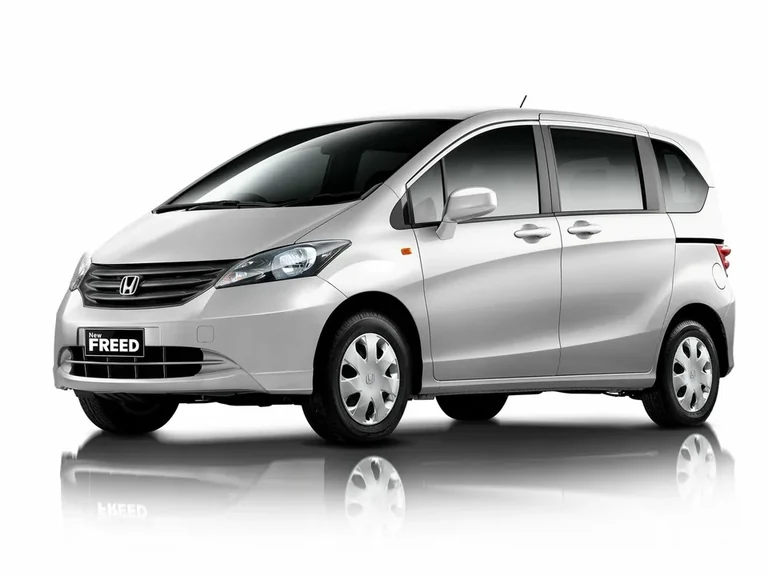
The first Freed came out with a single petrol engine – a 1.5-liter L15A i-VTEC with 87 kW (118 hp) at 6,600 rpm and 144 Nm at 4,800. Front-wheel drive cars received a CVT, all-wheel drive – a five-speed automatic transmission; This is important when choosing, because the all-wheel drive first Freed has a different gearbox, with a different character and consumption. Three seating options were offered: seven seats with separate seats in the second row, eight seats with a sofa and a five-seater Flex without a third row – Honda separately noted that the captain’s chairs and an eight-seater cabin in this class appeared in its class first.
After the update on October 28, 2011, the eight-seater version disappeared: the third row of all Freeds became a two-seater, and the cabin is now six- or seven-seater, depending on the second row. The five-seater version had already been separated into a separate Freed Spike model with a two-row cabin and a large trunk, and it was updated along with the Freed. At the same time, the first hybrid appeared. Freed Hybrid (GP3 code) is built on the IMA scheme: petrol 1.5 for 65 kW (88 hp) and 132 Nm works together with a thin electric motor for 10 kW (14 hp) and 78 Nm, which only helps the engine, and in total Honda measured 73 kW (99 hp) and 159 Nm. The hybrid gearbox is a CVT, the drive is only front, consumption on the JC08 cycle is 21.6 km / l against 16.6 for a petrol front-wheel drive car and 13.2 for an all-wheel drive car. The battery with the control unit is located under the floor of the third row; the floor there has risen by 65 mm, but Honda left the landing point at the same height, so in terms of the number of seats and landing, the hybrid does not differ from the usual Freed.
In the spring of 2014, the first generation was updated again, this time cosmetically, and produced until September 2016. When choosing such a car today, the main thing is not to confuse three things: petrol front-wheel drive with a CVT, petrol all-wheel drive with a five-speed automatic transmission and a hybrid that did not have all-wheel drive at all. In the body code, this is immediately visible: GB3 – 2WD petrol, GB4 – 4WD petrol, GP3 – hybrid.
Second generation GB5–GB8 (2016–2024): i-DCD robot and first hybrid with all-wheel drive
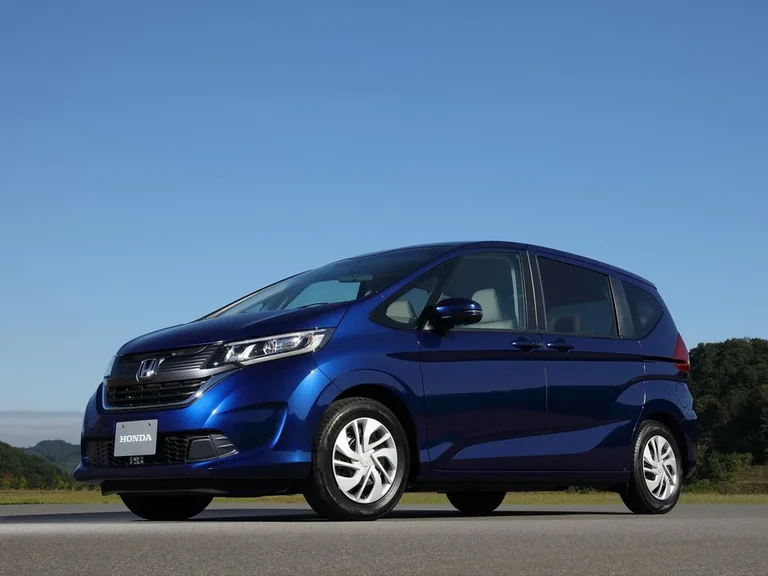
Since September 16, 2016, the equipment has been completely changed. The petrol engine became the L15B with direct injection – 96 kW (131 hp) at 6,600 rpm and 155 Nm at 4,600, still with a CVT, 19.0 km/l according to JC08. The hybrid switched to the SPORT HYBRID i-DCD scheme: an 81 kW (110 hp) and 134 Nm LEB engine, a 22 kW (29.5 hp) and 160 Nm electric motor, and between them is a seven-speed dual-clutch transmission, in which the engine is built-in. The battery is lithium-ion, and Honda moved it from under the third row under the front seats – this is what made it possible for the first time in the class of compact minivans to make an all-wheel drive hybrid. The consumption of the hybrid according to the JC08 is 27.2 km/l.
The interior has grown more than the body: with the same 2,740 mm base, the distance between the landing points of the first and third rows has increased by 90 mm, the longitudinal travel of the second row seats in the six-seater version has become 360 mm instead of 240, the opening of the sliding door has widened to 665 mm, and the height of the threshold has decreased to 390 mm. The Honda SENSING complex in 2016 was installed only on certain versions.
The October 18, 2019 update changed the exterior, added a crossover version of the Crosstar with an unpainted body kit and made the Honda SENSING standard for all versions, including a function that dampens an accidental jerk backwards in case of a pedal error. Petrol engine after the update is indicated with an output of 95 kW (129 hp) and 153 Nm. Production of the second generation ended in May 2024. The codes here are just as simple to read: GB5 and GB6 are petrol with front-wheel drive and all-wheel drive, GB7 and GB8 are a hybrid with front-wheel drive and all-wheel drive; the letter prefix DBA- or DAA- reflects the environmental class and does not affect the meaning of the numbers.
Third generation GT (from 2024): e:HEV, five, six or seven seats
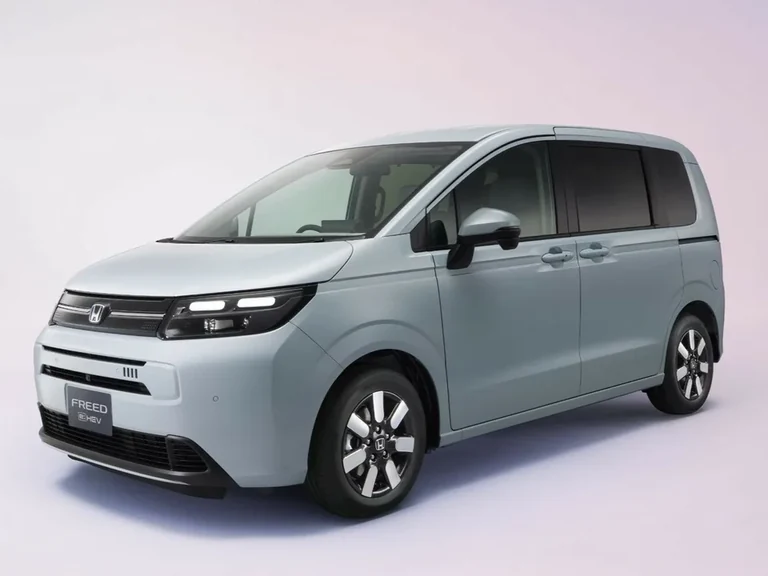
The new Freed has been on sale since June 28, 2024 and for the first time received a dual-motor e:HEV system, the same in the scheme as the Fit and Vezel: one motor works as a generator, the second drives the car, and the petrol engine is connected to the wheels directly only on a flat road on the highway. Honda’s numbers are as follows: the LEB-H5 engine with a volume of 1,496 liters produces 78 kW (106 hp) at 6,000-6,400 rpm and 127 Nm, the traction electric motor is 90 kW (123 hp) and 253 Nm from zero rpm. The petrol version remained in the lineup with the L15D engine at 87 kW (118 hp) at 6,600 rpm and 142 Nm at 4,300, with a CVT; In some catalogs, 129 hp are found for it, but this is the value of the previous generation, the new Freed Honda indicates 118. Real Time AWD all-wheel drive is available with both a hybrid and a petrol engine. According to the WLTC cycle, a hybrid with front-wheel drive fits into about 25 km / l, with a full one – about 21, petrol – about 16 and 14.5, respectively.
The cabin is offered in two versions – calm Air and underneath-protected Crosstar – and in three layouts: six seats with captain’s chairs in the second row, seven seats with a sofa and five seats in a two-row Crosstar, which took the place of Freed+. The body height has increased to 1,755 mm (1,780 for all-wheel drive), ground clearance – 135 mm for front-wheel drive and 150 for all-wheel drive. Honda SENSING with a wide-angle camera and eight sonars is on all versions. Body codes: 5BA-GT1… GT4 – petrol, 6AA-GT5… GT8 — e:HEV; It is already clear from the prefix whether it is a hybrid or not.
What places and what hybrid does a family need?
Six seats with captain’s chairs give a passage from the first row to the third between the seats: to let the third row passenger out, you do not need to recline the seat on which the child seat stands. The seven-seater sofa of the second row wins one seat and loses the aisle – the third row is available only after folding part of the sofa. If the third row is rarely needed, and the trunk is constantly needed, it is more logical to look at two-row versions: Freed Spike of the first generation, Freed+ of the second or five-seater Crosstar of the third – their trunk is arranged for the cargo, and not for the third row.
The choice between hybrids comes down to how the car will be used. The first-generation IMA is essentially a petrol Freed with acceleration assistance and lower consumption, without all-wheel drive. The second-generation i-DCD gives noticeably lower consumption and all-wheel drive, but its dual-clutch transmission does not behave like a CVT: when inspecting, you should pay attention to the smoothness of starting and shifting at low speed. The third-generation e:HEV has an electric motor in the city, and the engine is mainly powered by a generator; its 253 Nm from zero is the most “electric” of the three circuits.
What to check for a specific Freed
First, the body code: it unambiguously separates the generation, hybrid and drive, while the name of the G trim level, Just Selection, Hybrid EX or Crosstar is repeated in different years. How to read the code and where it is written is analyzed in a separate article. Next is the number of seats according to the documents, not from the photo: six- and seven-seater cars do not differ externally. For the first generation, it is additionally worth checking the gearbox – a CVT or a five-speed automatic transmission – and for the hybrid: only the GB8 and the third-generation e:HEV have full drive.
The equipment is highly dependent on the version. The electric sliding doors could be on one side, on both or not; Honda SENSING until October 2019 is an option for individual versions, after – standard, for the third generation – always. Owners of the first generation separately note the lack of a spare tire; for newer cars, it is also better to check the availability of a spare tire or repair kit for a specific version. All this is convenient to check the catalog pages for the years of release of the versions – 2008, 2011, 2014, 2016, 2019 and 2024; for two-row versions, there are separate Freed Spike and Freed+ pages. The order in which GTYRES looks at the selected lot before bidding is described in the article on checking the car before bidding.