Minivans from Japan: how to choose a family car
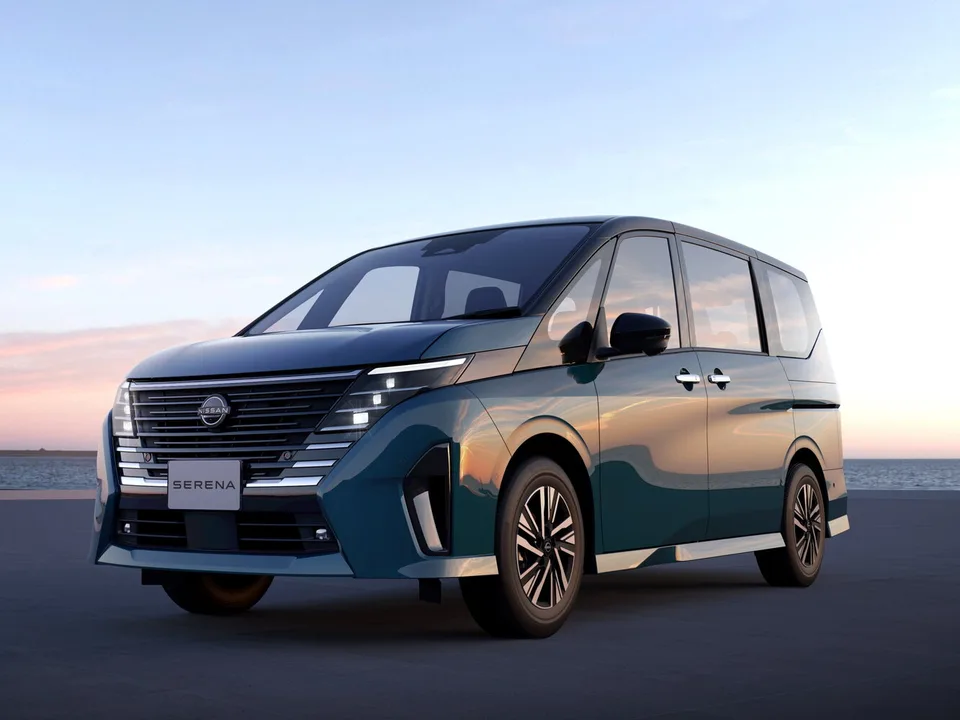
A Japanese minivan needs to handle everyday family life: three passengers in the second row, sliding doors that open in a tight courtyard, and room for luggage without folding away half the seats. The models commonly bought at auction differ in size and layout. Some fit three rows into a body just over four metres long; others have an interior more than three metres long, or put second-row comfort ahead of the third row. This guide will help you choose the right format for your family and find a more detailed model guide once you have narrowed the choice.
How many rows do you really need?
Start with how often you need the third row. Factory specifications give the Japanese-market versions an interior length of 2545 mm for the seven-seat Sienta, 2645 mm for the Freed AIR, 2805 mm for the Voxy, 2845 mm for the Stepwgn and 3145 mm for the Serena. The 600 mm difference between the Sienta and Serena is shared between three rows and the luggage area, so judge the space against your own passengers and luggage: who will sit at the back, how far they will travel, and whether a pushchair, suitcases or bags must fit behind them. If you only use the third row a few times a month, it can be folded away to leave a flat floor in the compact models. If you do not need it at all, some models offer two-row versions. The third-generation Sienta has a five-seat version with a 2030 mm interior and a flat load floor; its luggage compartment is 50 mm taller than that of the previous two-row version. Seat counts also vary within a generation: the Sienta has five or seven, the Freed five, six or seven, and the Stepwgn and Voxy seven or eight. The Serena has eight seats in petrol and front-wheel-drive e-POWER versions, and seven in the all-wheel-drive e-4ORCE and flagship LUXION. Seven seats describe a particular version, not the whole model range.
Three size groups of Japanese minivans
| Japanese-market model and generation | Seats | Body dimensions and wheelbase, mm | Drivetrain |
|---|---|---|---|
| Toyota Sienta, 3rd (XP210), from 2022 | 5 or 7 | 4260 × 1695, wheelbase 2750 | front-wheel drive or all-wheel drive (E-Four on the hybrid only) |
| Honda Freed, 3rd (GT), from 2024 | 5, 6, or 7 | 4310, width 1695 for AIR and 1720 for CROSSTAR, wheelbase 2740 | front-wheel drive or all-wheel drive |
| Nissan Serena, 6th (C28), from 2022 | 8, e-4ORCE and LUXION have 7 | 4690 × 1695 for regular versions, 4765 × 1715 for Highway Star V and LUXION, wheelbase 2870 | front-wheel drive or all-wheel drive |
| Toyota Voxy, 4th (R90), from 2022 | 7 or 8 | 4695 × 1730, wheelbase 2850 | front-wheel drive or E-Four all-wheel drive |
| Honda Stepwgn, 6th (RP6–RP8), from 2022 | 7 or 8 | 4800 for AIR and 4830 for SPADA, width 1750, wheelbase 2890 | front-wheel drive or all-wheel drive; e:HEV hybrid is front-wheel drive only |
| Toyota Alphard, 4th (H40), from 2023 | 6, 7, or 8 | 4995 × 1850 × 1935, wheelbase 3000 | front-wheel drive or all-wheel drive |
Width matters more than length here: it determines whether you can pass another car in a narrow courtyard and fit into an older garage. The Sienta and Freed AIR are 1695 mm wide, while the Freed CROSSTAR’s protective wheel-arch trim adds 25 mm, taking it to Honda’s stated 1720 mm. Standard Serena versions are also 1695 mm wide; the Highway Star V and LUXION are 1715 mm, the Voxy 1730 mm and the Stepwgn 1750 mm. The Alphard is a separate proposition. Toyota says the new generation fits within the limits of typical automated parking systems: no longer than 5000 mm and no wider than 1850 mm. At 4995 × 1850 mm, it leaves no spare width and only five millimetres in length. Meeting those limits does not guarantee it will fit a particular garage or parking system. Check the site’s posted limits, including the separate height restriction for a vehicle 1935 mm tall.
Compact models: Sienta and Freed
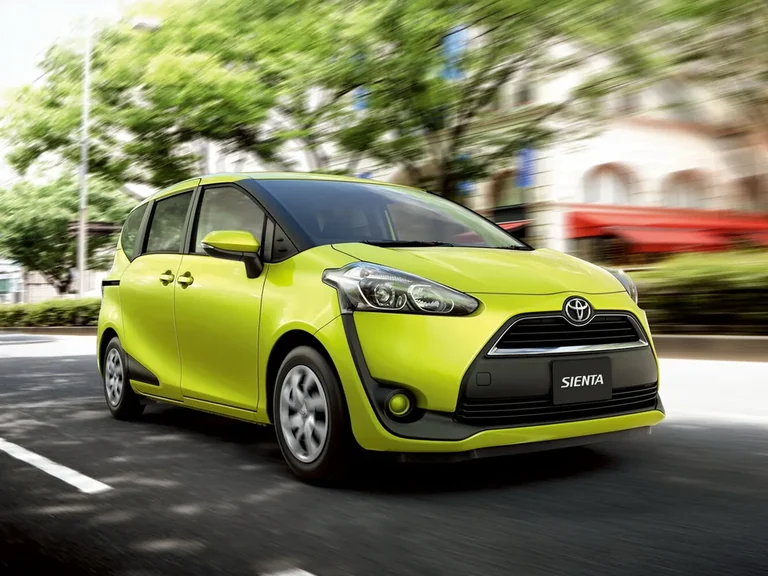
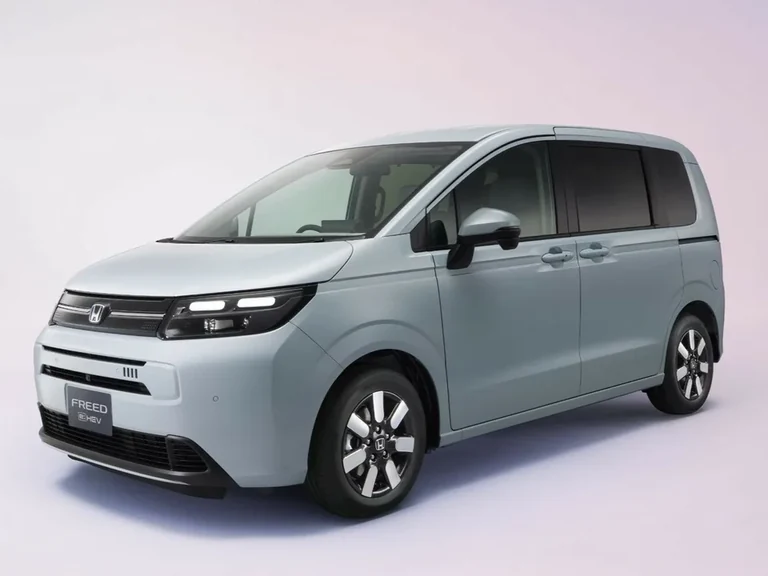
Both models fit three rows into roughly the footprint of an ordinary hatchback. The third-generation Sienta measures 4260 × 1695 mm and has a turning radius of 5.0 m. Its sliding-door sill is 330 mm high, allowing a child to climb in without being lifted. Across three generations, the Freed has grown from 4215 to 4310 mm. Honda’s third-generation factbook says it limited the extra length required by the e:HEV hybrid system to 45 mm: that is how much longer the three-row car is than its predecessor. The front-wheel-drive, two-row CROSSTAR grew by 15 mm. The Freed has a 5.2 m turning radius and a 2740 mm wheelbase. Width depends on the version: AIR is 1695 mm, while CROSSTAR’s wheel-arch trim takes it to 1720 mm. Those 25 mm can matter in a narrow courtyard. Interior layouts differ more than the exterior dimensions suggest. The third-generation Freed offers five, six or seven seats; the six-seat version has separate second-row seats with an aisle to the third row. For a closer look at generations and versions, see our guides to the Sienta and Freed. Their catalogue pages are Toyota Sienta and Honda Freed.
Mid-size: Serena, Stepwgn and Voxy
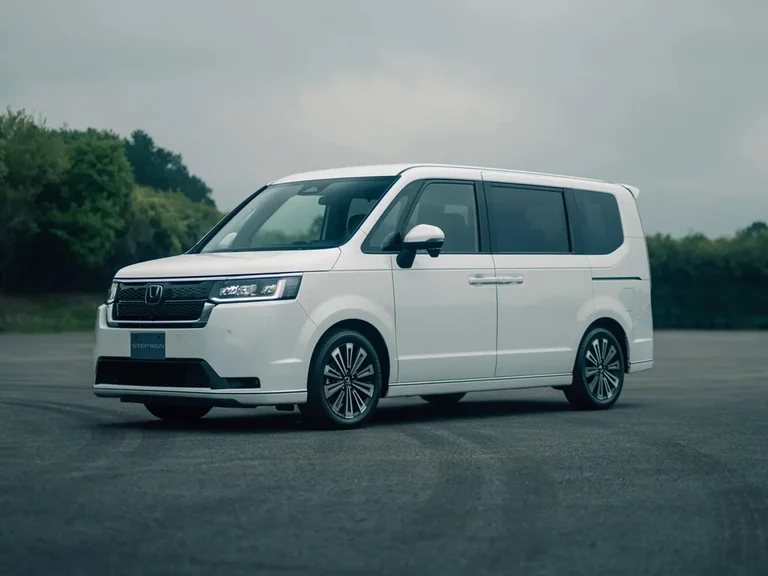
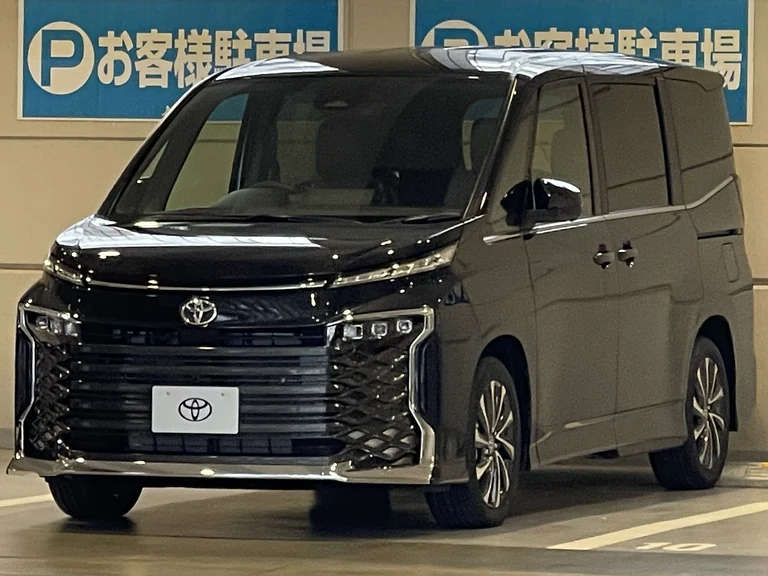
This size class suits families who use the third row every day. Factory figures for the sixth-generation Serena are 4690 × 1695 × 1870 mm for standard versions and 4765 × 1715 mm for Highway Star V and LUXION. All share a 2870 mm wheelbase and a 5.7 m turning radius. Petrol and front-wheel-drive e-POWER versions have eight seats; all-wheel-drive e-4ORCE and LUXION versions have seven. Check seating and drivetrain together. The Serena offers useful features for tight spaces: a sliding door operated by moving your foot beneath the sill, and a tailgate whose upper section can open separately when there is little room behind the car. The sixth-generation Stepwgn is larger: 4800 mm long in AIR form and 4830 mm as a SPADA, with a width of 1750 mm and a 2890 mm wheelbase. It no longer has the side-opening section of the Waku Waku Gate; its tailgate opens upwards as one piece. Toyota’s September 2026 specification table gives the fourth-generation Voxy dimensions of 4695 × 1730 mm and a 2850 mm wheelbase. Its chassis code identifies the engine variant, making the code more useful than appearance when checking a version. See our generation guides for the Serena, Stepwgn and Voxy, or the catalogue pages for the Nissan Serena, Honda Stepwgn and Toyota Voxy.
Alphard: When a big cabin is justified
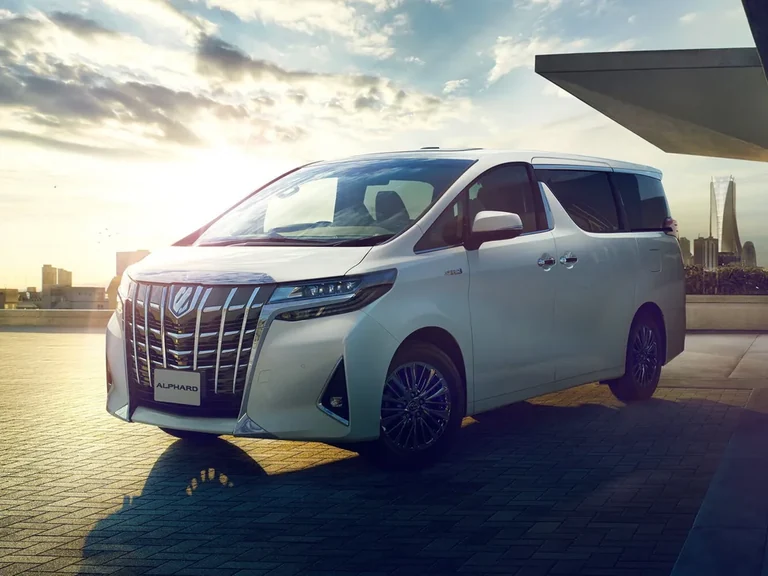
People choose the Alphard for its second row: that is where the main passenger sits. The fourth generation measures 4995 × 1850 × 1935 mm on a 3000 mm wheelbase, with six, seven or eight seats listed in the catalogue. The previous generation gained a 148-litre compartment under the third row, while the front passenger seat could slide 1160 mm towards the rear row. Its size is the trade-off: at 1850 mm wide, you need to check courtyard access and parking space in advance, and servicing is on a different scale. When comparing the Alphard with mid-range cars, start with how you will use it: how often the third row will be occupied, who will sit in the second, and what it costs to accommodate a car 1850 mm wide and 1935 mm tall. For details on the generations and engines, see the separate Alphard guide; the model page is in the catalogue.
Doors, third row and luggage
All six models have sliding doors, but their everyday convenience varies. Check the sill height, the width of the opening, and whether power operation is fitted on both sides or only the left. The third-generation Sienta has a sliding-door opening 1200 mm high and a sill height of 330 mm, or 350 mm on the all-wheel-drive E-Four. That difference matters when carrying a child and a backpack. Third-row seats also fold differently. From the fourth generation onwards, the Stepwgn’s third row folds under the floor; in other models the seats fold towards the sides, affecting the space left for a pushchair. Assess luggage space with the things you actually carry, rather than litres alone. Place your usual pushchair, child seats or suitcases behind the raised third row, and check the listing to see how the seats fold and how high the tailgate opening is.
What is hidden behind the word “hybrid”
The word hybrid covers several systems, affecting both how the car drives and whether all-wheel drive is available. On the Serena it can mean S-HYBRID with a small assistance motor, first-generation e-POWER with a 1.2-litre engine generating electricity, or second-generation e-POWER with a 1.4-litre generator engine. Honda uses e:HEV; on the sixth-generation Stepwgn it is available only with front-wheel drive. The Voxy gained a hybrid in 2014, but that version remained front-wheel drive until 2022. On the latest Sienta, by contrast, all-wheel drive is available only with the hybrid. For most of the Alphard hybrid’s history, it came exclusively with electric E-Four all-wheel drive; a front-wheel-drive hybrid appeared only in 2023. Do not assume that every hybrid offers all-wheel drive: check the particular generation and version.
What to check before bidding
First, check the seat count and second-row layout. Both can vary within a generation, and the version name in the auction listing helps identify them. Next, check the chassis code: on Japanese minivans it identifies the engine and drivetrain variant. Our separate guide explains how to read it. Use dimensions for the specific version rather than the model as a whole: a standard Serena and a Highway Star V differ by 75 mm in length and 20 mm in width. Inspect the sliding doors’ power mechanisms and guides separately, because they work every day. For hybrids, the production year and type of system matter more than the word hybrid in the listing. If catalogue data conflicts with the documents for a particular car, confirm its drivetrain and specification from the auction documents. Our auction sheet guide explains the inspector’s grades and notes. Once you have chosen the model and generation, follow the usual process for choosing and buying a car from Japan.
Toyota Voxy R90 photograph: Wikimedia Commons, by Tokumeigakarinoaoshima, licensed under CC BY-SA 4.0.